
From networks to stew: a visual and conceptual experiment on relations
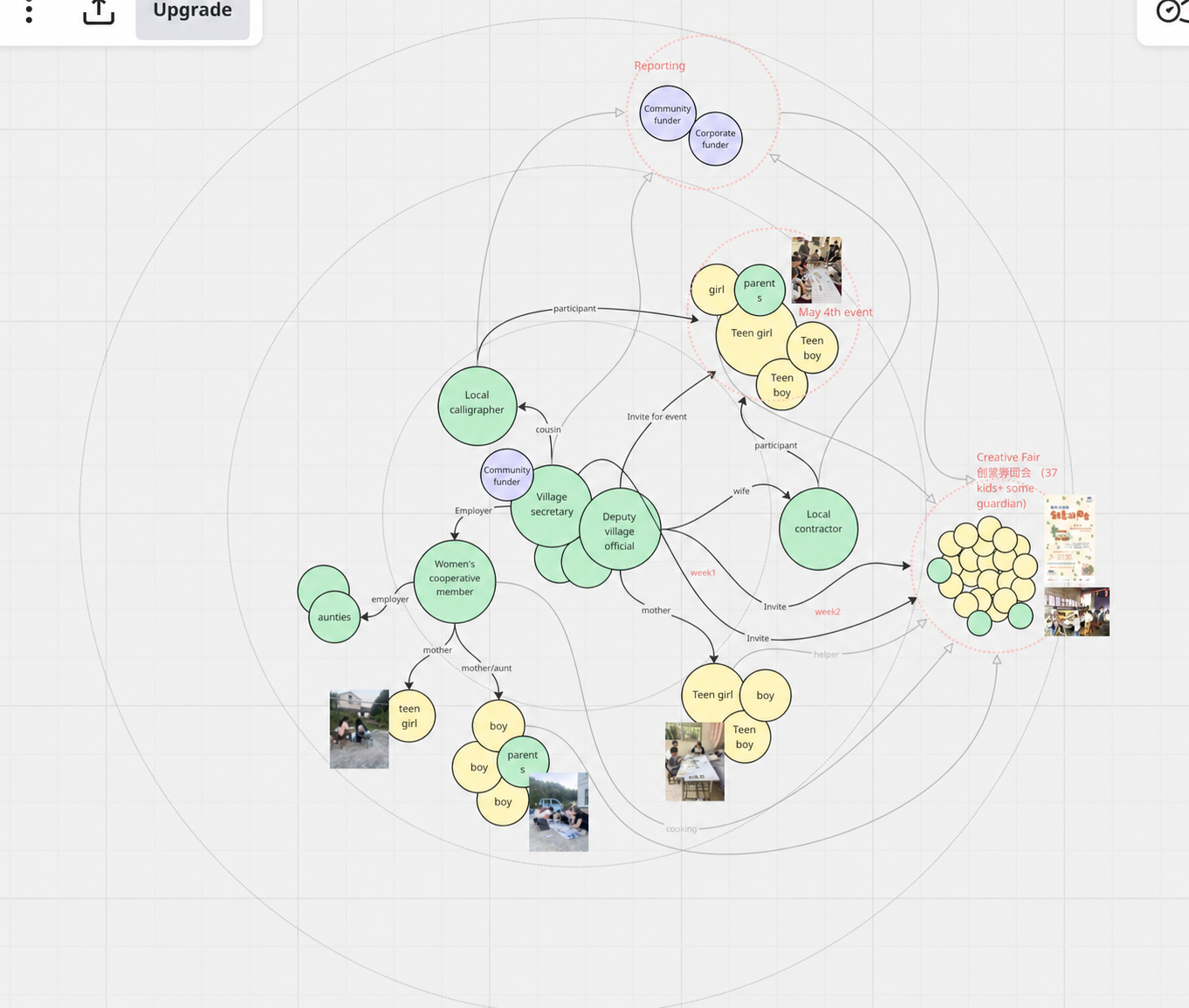
As a continuation of the previous blog post, Entering twice, I recently tried to draw how my relationships had expanded and transformed during a long-term co-design engagement in D Village.
While I was taking fieldnotes, I drew myself near the centre of the page. Around me, I placed the people I had encountered: the village secretary, local volunteers, the contractor, members of the women’s cooperative, children and teenagers, families, and local officials. I used concentric circles to represent successive visits and events. Each circle marked another occasion through which my relational world in the village had widened.
The drawing was useful. It showed me that entering the village had not happened in one moment. My official arrival, when I was introduced as the commissioned designer, had been only one kind of entry. Other entries occurred gradually: through a car journey, a lunch, a muddy morning clearing an irrigation channel, a conversation before a meal, a visit to someone’s home, and the accumulation of WeChat messages that continued between visits.
But the longer I looked at the drawing, the more unsatisfied I became.
It still looked like a stakeholder map.
The actors were stable dots. The relationships were lines. Time merely added more dots and more lines. And although the map was based on my own experience, its viewpoint floated somewhere above the village. From this God’s-eye position, I appeared able to see the whole relational system at once.
The map was not wrong. But it made me wonder whether the familiar shape of a network was quietly deciding what a relation could look like.
[Visual experiment 1: The original concentric-circle map. Manually drawn in Miro. Names are removed for anonymity.]
The hidden metaphor in a network
Designers draw networks constantly. We make stakeholder maps, actor maps, ecosystem maps, partnership maps, and service maps. Even when the labels change, the visual grammar is usually similar: entities appear as nodes and relations appear as lines between them.
This grammar is so familiar that it can seem neutral. Yet a network is already a metaphor. It invites us to imagine social life in the shape of a net.
A net begins with knots and threads. Translated into a diagram, people and organizations become knots, while relationships become threads connecting them. The actors are assumed to exist first. Relations are then added between them.
This way of drawing is useful when I want to ask who is involved, who communicates with whom, but I found it troubling.
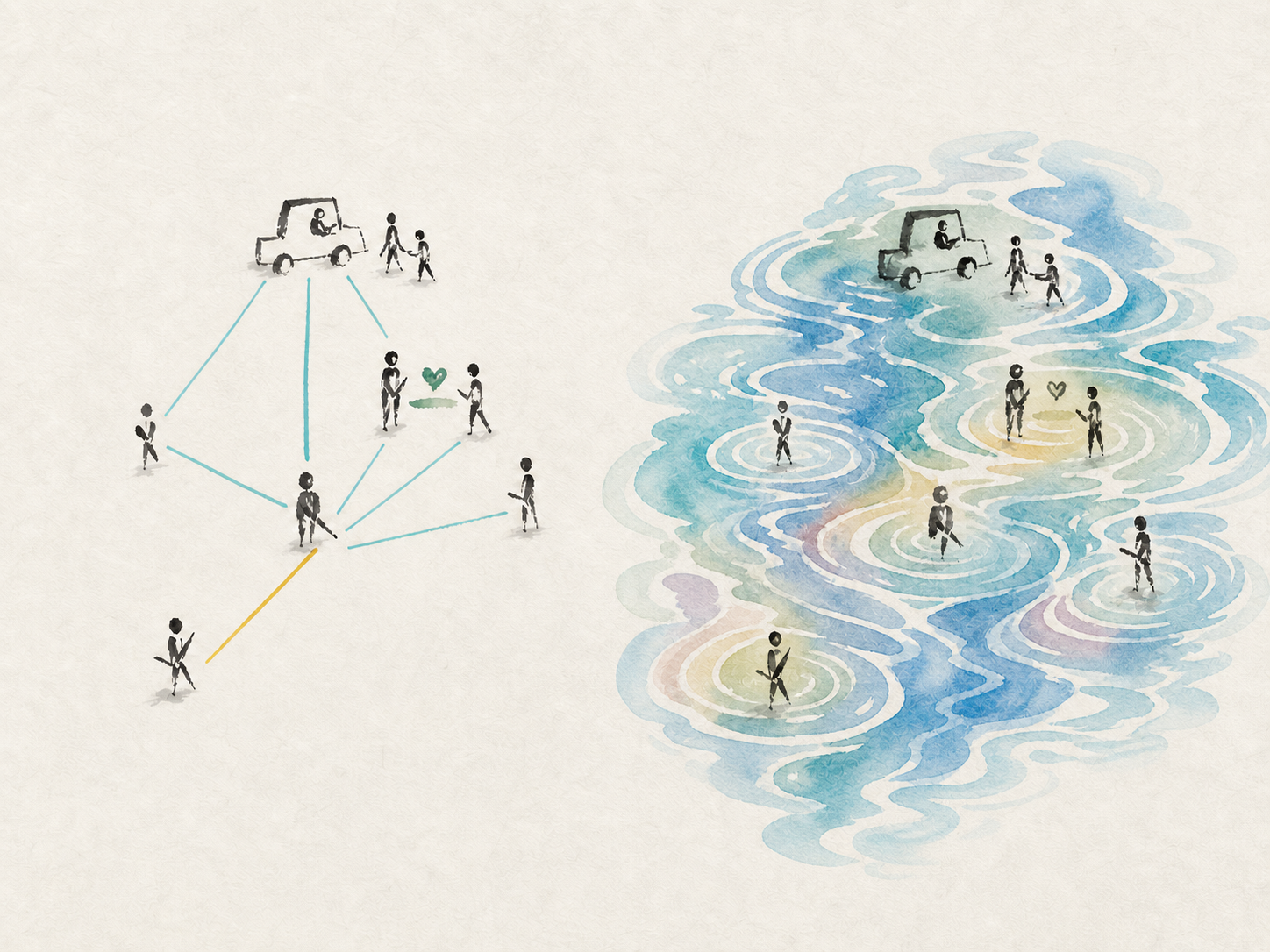
First, actors appear as fixed nodes with stable roles: designer, village secretary, funder, contractor, child. Second, relations appear as lines that pass between these actors without changing them. Information, trust, resources, or influence may travel along an edge, but the nodes at either end remain visually intact. Third, the medium through which any relation becomes possible is absent. The space between the nodes is left empty, concealing moods, tools, places, histories, bodily encounters, and accumulated time through which people become related at all.
These limitations brought me back to Bruno Latour and Actor-Network Theory. ANT offers a more disruptive proposition than the familiar image of “actors connected in a network”. In the Latourian sense, actors do not enter relations as complete and unchanging entities. They take form through their associations. This shifts attention away from identifying stable nodes and toward foregrounding the mediators through which a situation, and the actors within it, are transformed.
Latour also distinguishes an intermediary from a mediator. An intermediary transports something without changing it. A mediator transforms what passes through it.
This distinction helped me see my encounters in D Village differently. A contract did not simply carry an agreement between the funder, village, and contractor. It orchestrated particular formal responsibilities that many of us were bound to enact. A meal did not merely create a friendly setting in which existing actors exchanged information. It changed what could be said, who could speak, and what kind of person I was becoming in relation to those present. A hoe was not simply a tool connecting my intention to an irrigation channel. Through its weight and resistance, it repositioned my body among other working bodies and made another kind of encounter with village life possible.
The contract, meal, and hoe were not thin lines between unchanged nodes. They were mediators through which the situation—and the actors within it—became different.
[Visual experiment 2: Draw the same episode twice. First using a conventional network archetype: “designer—villagers.” Then redraw by foregrounding a thick mediating situation in which roles, concerns, speech, hospitality, and obligation are being transformed. (Developed with ChatGPT based on iPad sketches.)]
Thinking with tāng
While searching for another way to visualize this relational medium, I began thinking about tāng (汤, pronounced approximately “tahng” in Mandarin and “tong” in Cantonese) .
The immediate English translation of tāng is “soup”. In English, “soup” can evoke a homogenized mixture: ingredients blended until their boundaries disappear into a smooth and uniform liquid. That is not the image I have in mind. Chinese tāng is commonly made by simmering visibly distinct ingredients in water over time. Pieces of meat, bones, corn, lotus root, mushrooms, red dates, goji berries, and medicinal herbs may remain recognizable in the pot. They do not melt into sameness. Yet none leaves exactly as it entered. Their flavours travel through the broth, altering the medium and one another [1].
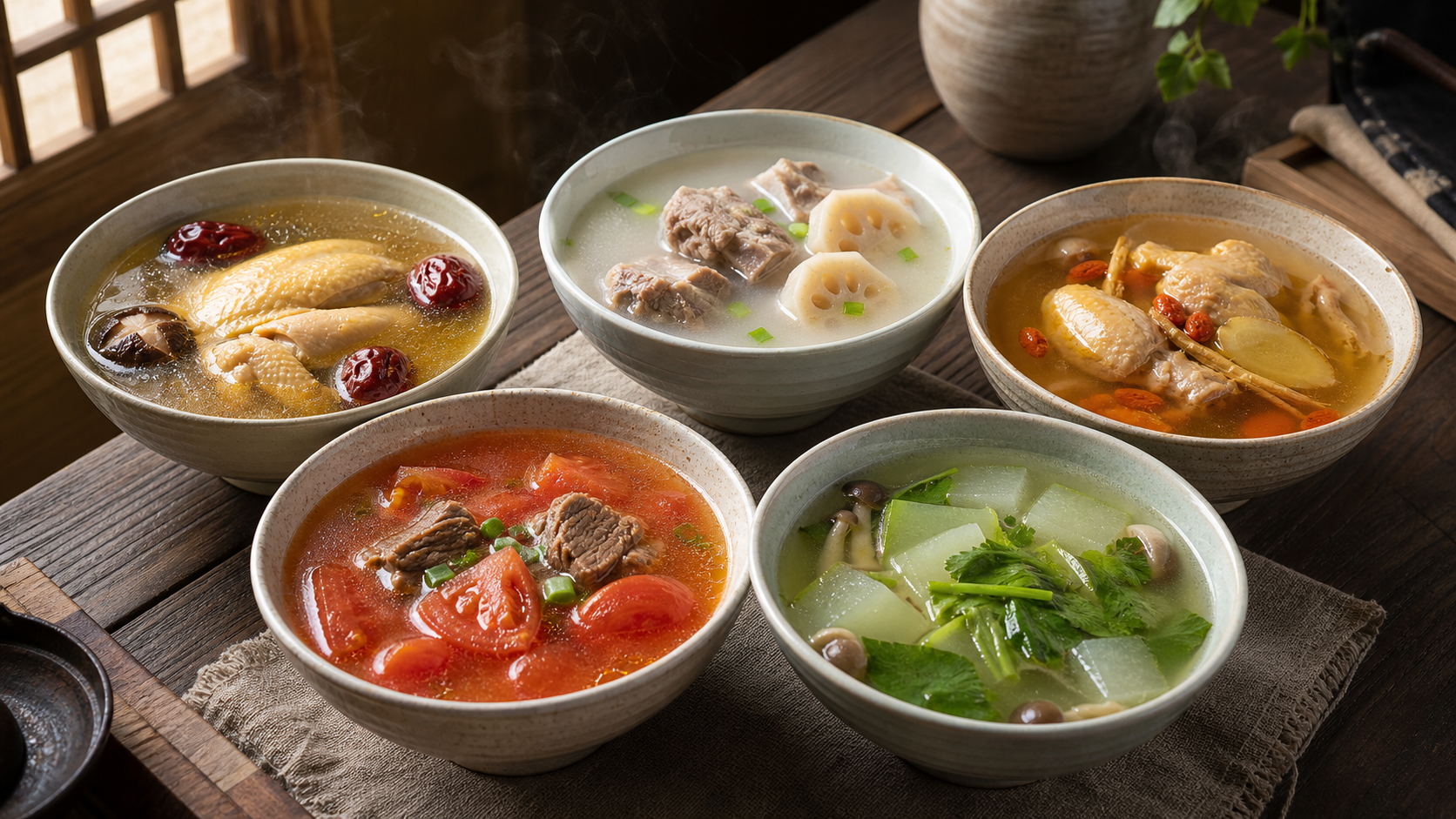
Assorted tāng (汤). Imaged developed with ChatGPT.
Crucially, the broth in tāng is not merely a container for the ingredients. It is often the most valued part of the experience. In Cantonese soup traditions, the broth may be treated as the essence of the dish and the primary thing to be enjoyed, while the still-intact ingredients are sometimes secondary or optional to eat. This gives the metaphor additional force: the medium is neither empty space nor a passive carrier. It is something the ingredients and time have collectively produced, and something that, in turn, carries their transformations [2].
I derive the metaphor from tāng, the Chinese practice of simmering distinct ingredients in a shared broth. For accessibility, while retaining tāng to mark the culturally situated practice from which the analytical metaphor emerged, from this point onward, I use “stew” for the more portable analytical idea.
The stew metaphor shifts the figure and ground of the network.
In a network diagram, actors occupy the foreground while the space between them remains empty. In a stew, the medium (broth) comes forward. Ingredients are immersed within something that carries flavour, heat, history, and change.
Time also becomes more than a sequence of added connections. A pot containing all the correct ingredients is not yet a stew. Simmering is constitutive. It creates the conditions through which ingredients begin to affect one another.
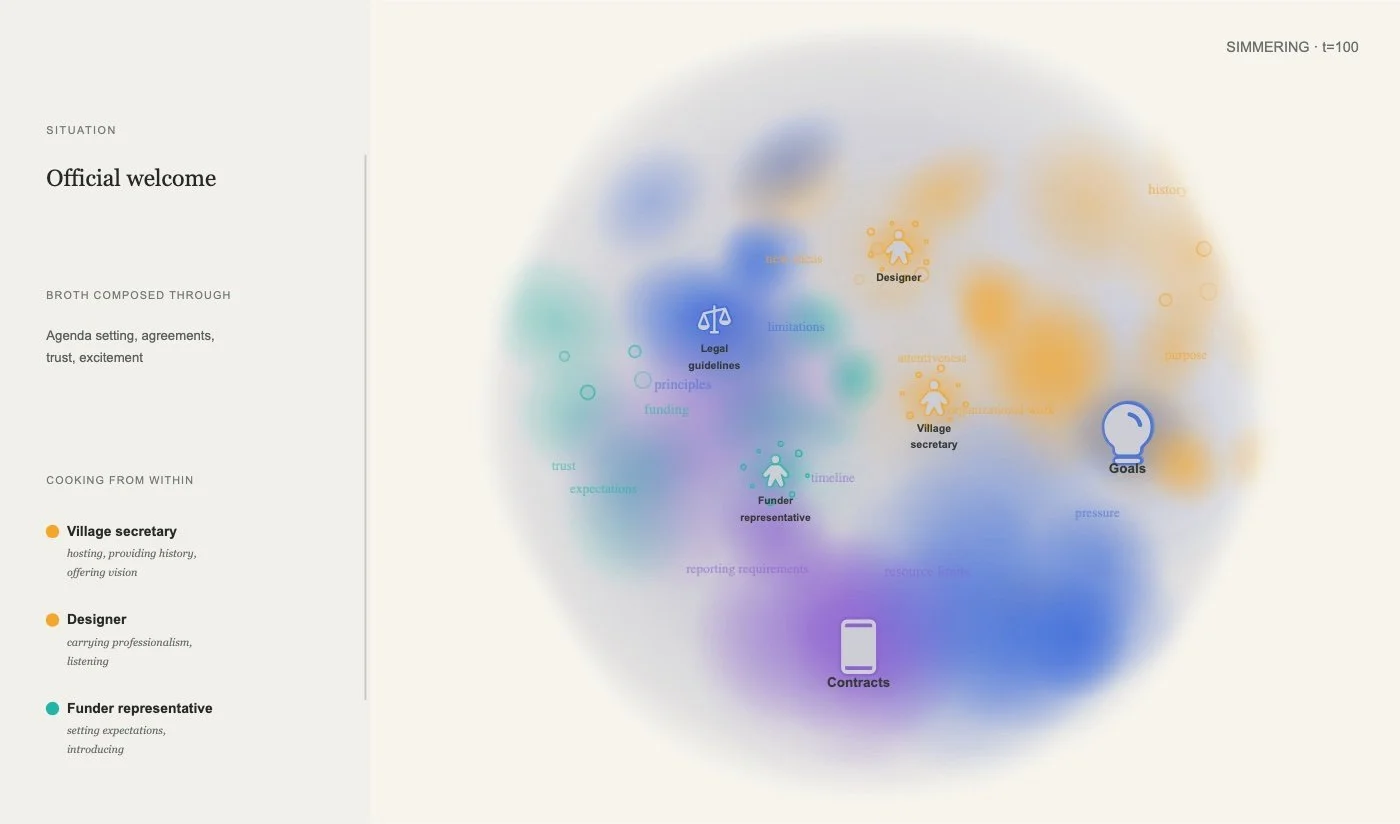
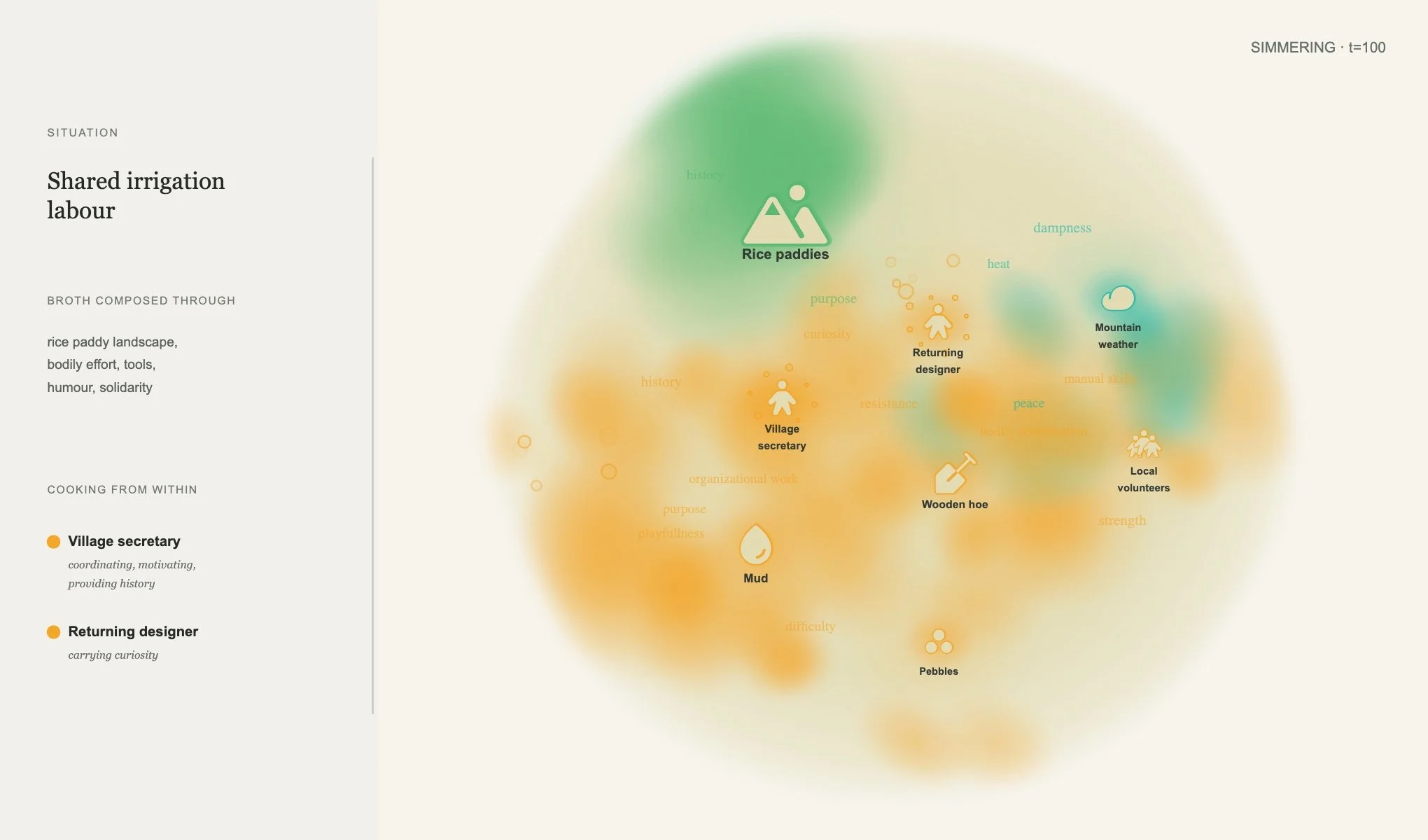
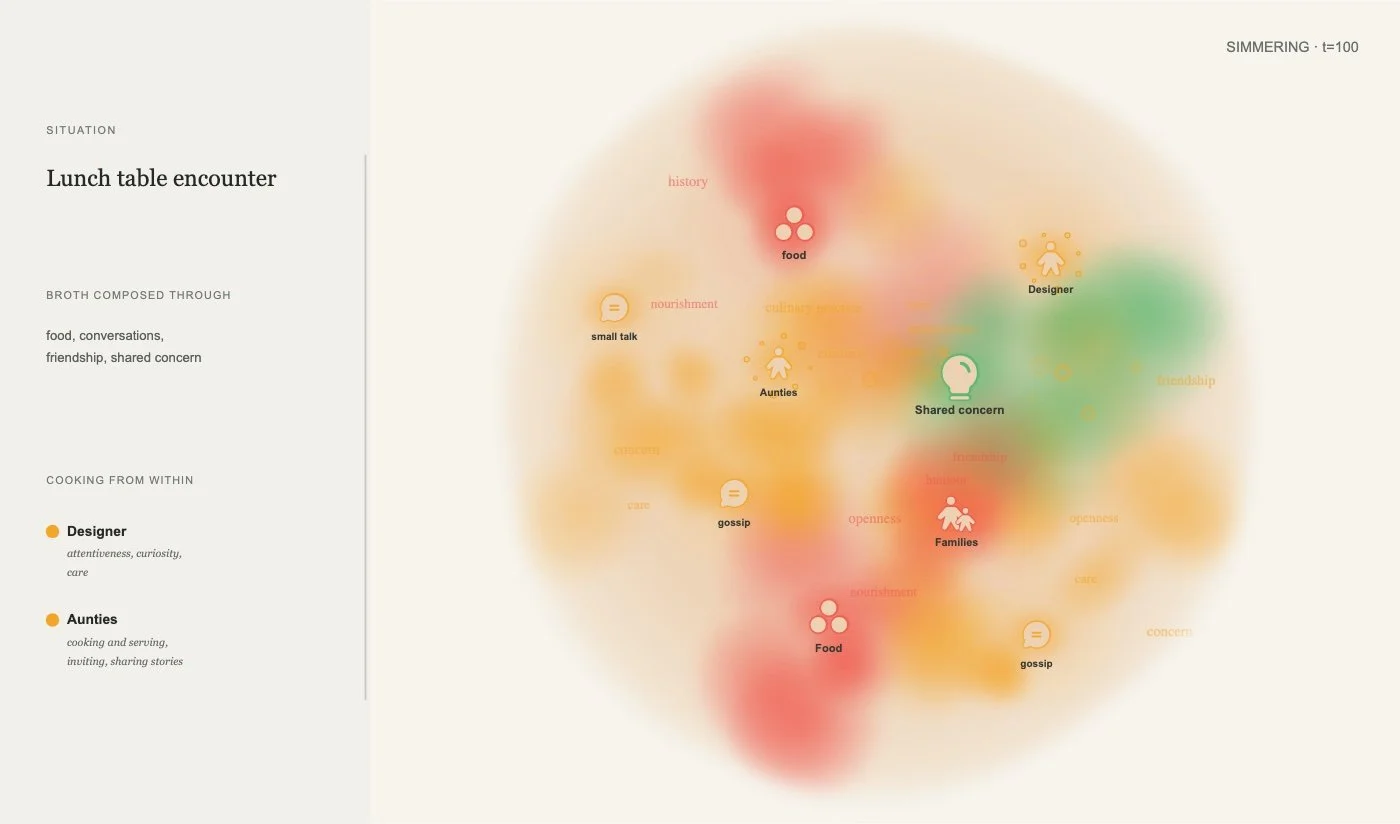
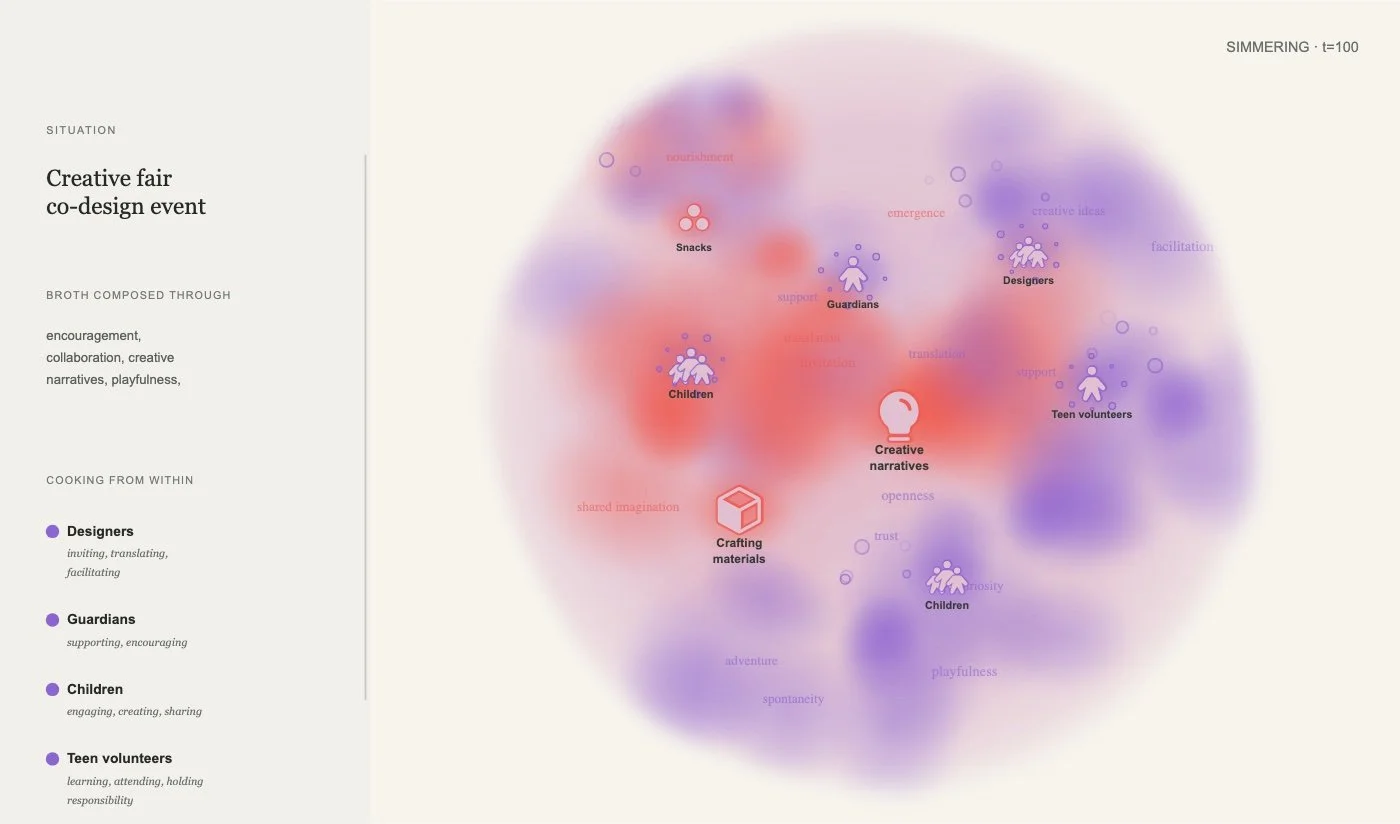
This felt closer to my experience in the village. My relational world did not change only because I encountered more people. Often, the people remained the same while the situation in which we encountered one another changed. Each situation produced a different stew. In an official meeting, the broth was flavoured by credentials, institutional roles, project scope, and the need to remain “in business.” Over a meal, during a car journey, or while working together in an irrigation channel, the same people were immersed in hospitality, bodily effort, humour, gossip, or shared time. These media did not merely alter the atmosphere around otherwise stable actors. They allowed us to become different people to one another.
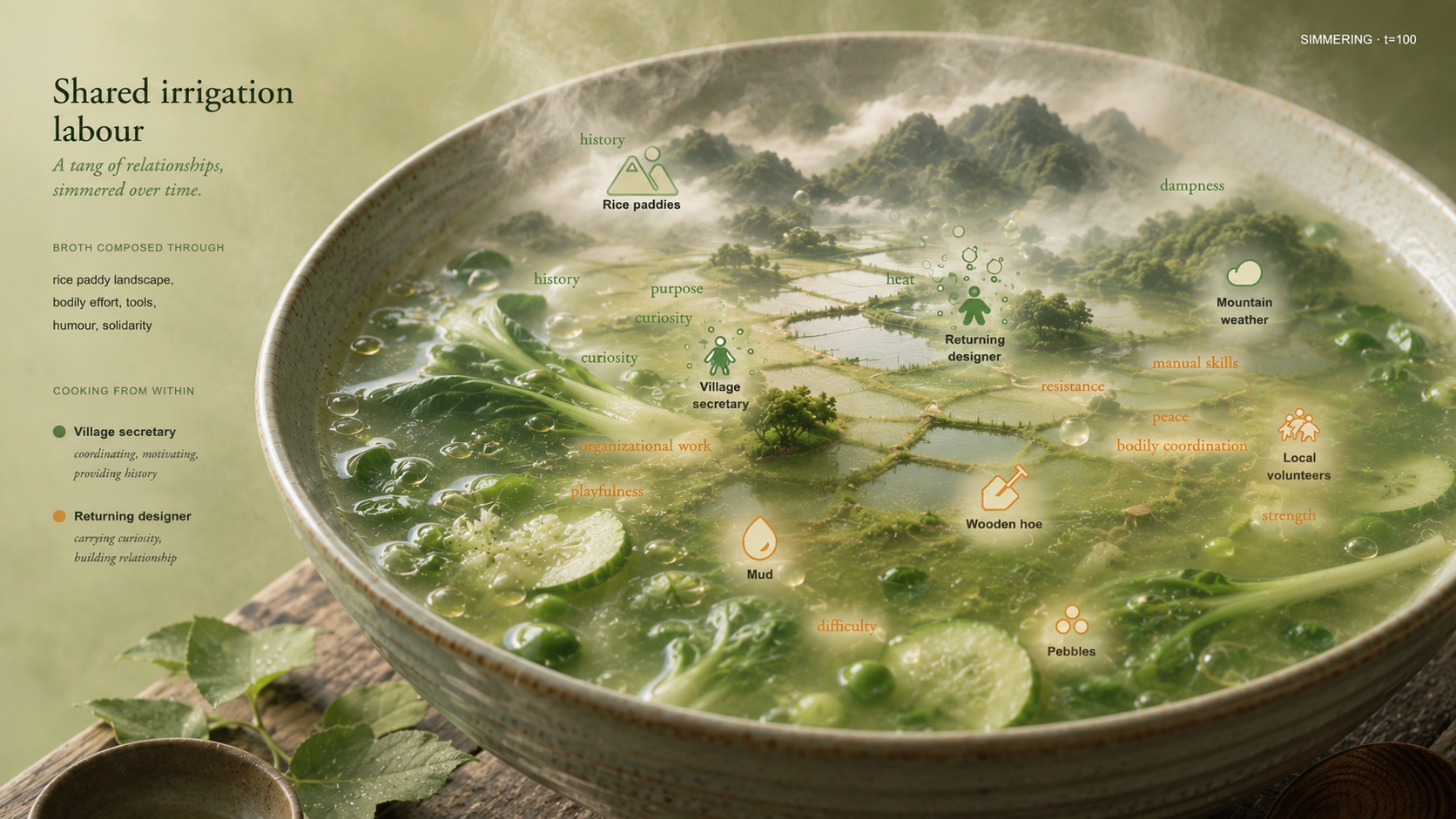
When the village secretary first welcomed me, the official introduction temporarily stabilized us as “village secretary” and “commissioned designer.” During the Youth Day activity, the hoe, mud, aching bodies, and teasing conversation enacted another configuration: she became an organizer moving between groups, the local contractor became an experienced co-worker looking out for me, the teenagers became companions in physical labour rather than target participants, and I became an awkward volunteer learning how to use my body in the village. Later, around the lunch table, hospitality and conversation made it possible for design ideas and concerns to circulate in ways that the formal project brief had not anticipated. The ingredients were recognizably the same, but the stew had acquired another flavour, and, within it, so had we.
I am beginning to think of these changes as relational reconfigurations with ontological effects: moments when a changing situation altered not only how actors were connected, but who and what they could become in relation to one another. These changes were neither permanent nor complete. Once the activity ended or the table was cleared, another configuration could take form. For visual analysis, however, I might temporarily stabilize several such moments as distinct stews. Placed sequentially, they could show not simply how my network expanded, but how successive encounters repositioned us, reshaped the project, and changed what I became able, or obliged, to notice. Earlier stews also seasoned later ones: the village secretary’s introduction shaped how others received me, while my response to one peripheral concern affected whether another might later be entrusted to me.
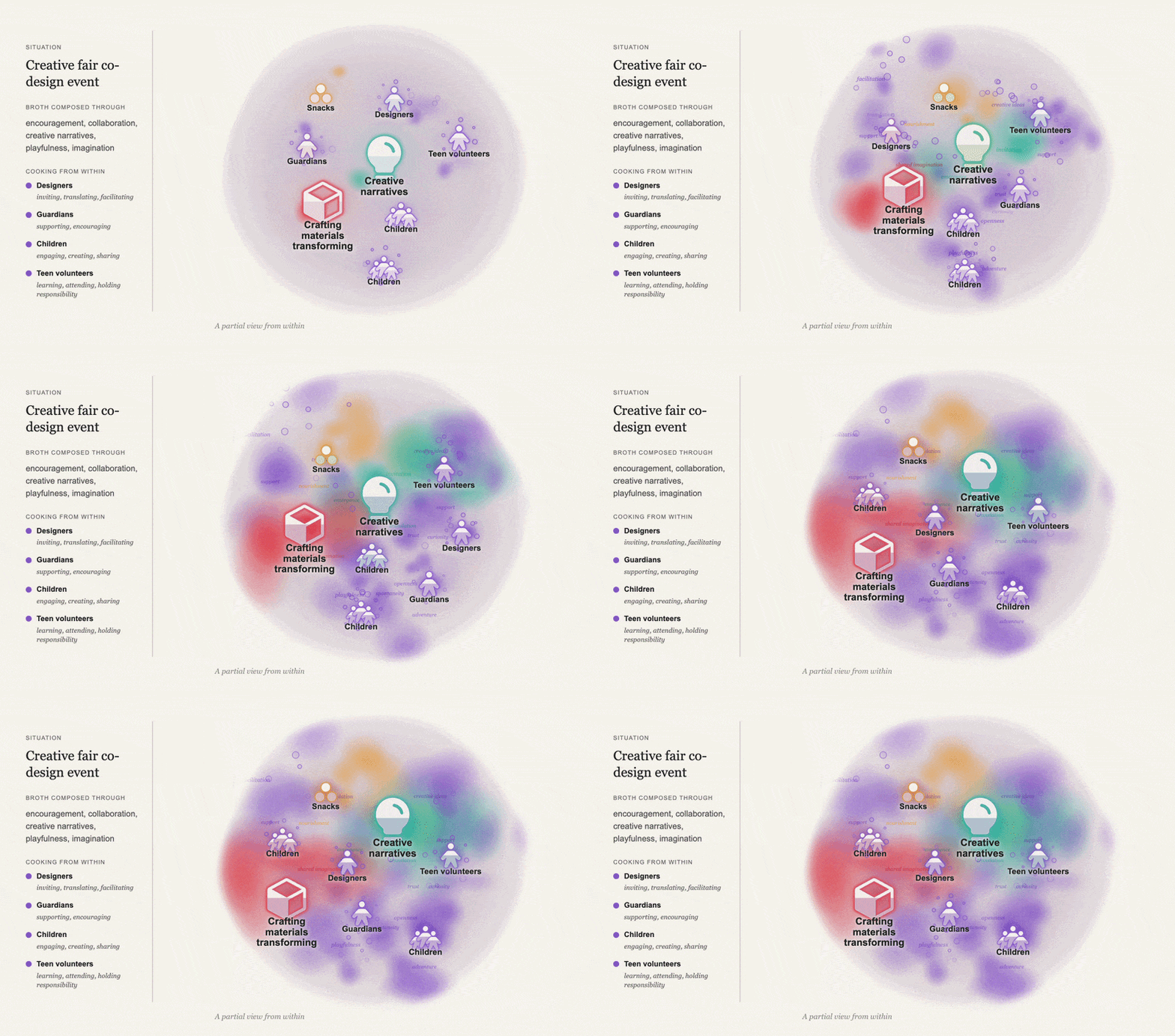
[Visual experiment 3: Four temporarily stabilized stews: the official welcome, shared irrigation labour, the lunch-table encounter, the creative fair co-design event. Each stew shows the ingredients, how they have contributed to the situation, and foregrounds the broths. (Generated with a browser-based software prototype, more details below.)]
The cook inside the stew
The metaphor immediately produced another problem: where is the cook?
If the cook stands outside the pot, adding ingredients and controlling the heat, I have merely reproduced the familiar image of the designer as an expert acting upon a passive social world. The network has become a pot, but the ontology has not changed.
I want to insist that the cook is fully inside the stew.
This is where my experiment moves from Latour’s relational thinking toward phenomenology. Heidegger’s idea of being-in-the-world refuses the image of a self-contained subject who first stands apart from the world and then chooses to enter it. Merleau-Ponty’s embodied phenomenology goes further in showing how perception arises through a body already immersed in what it is trying to understand.
From this perspective, I do not observe the relational field from outside. I encounter it through heat, smell, texture, fatigue, anticipation, awkwardness, affection, and resistance. My understanding develops while I am acting and being acted upon.
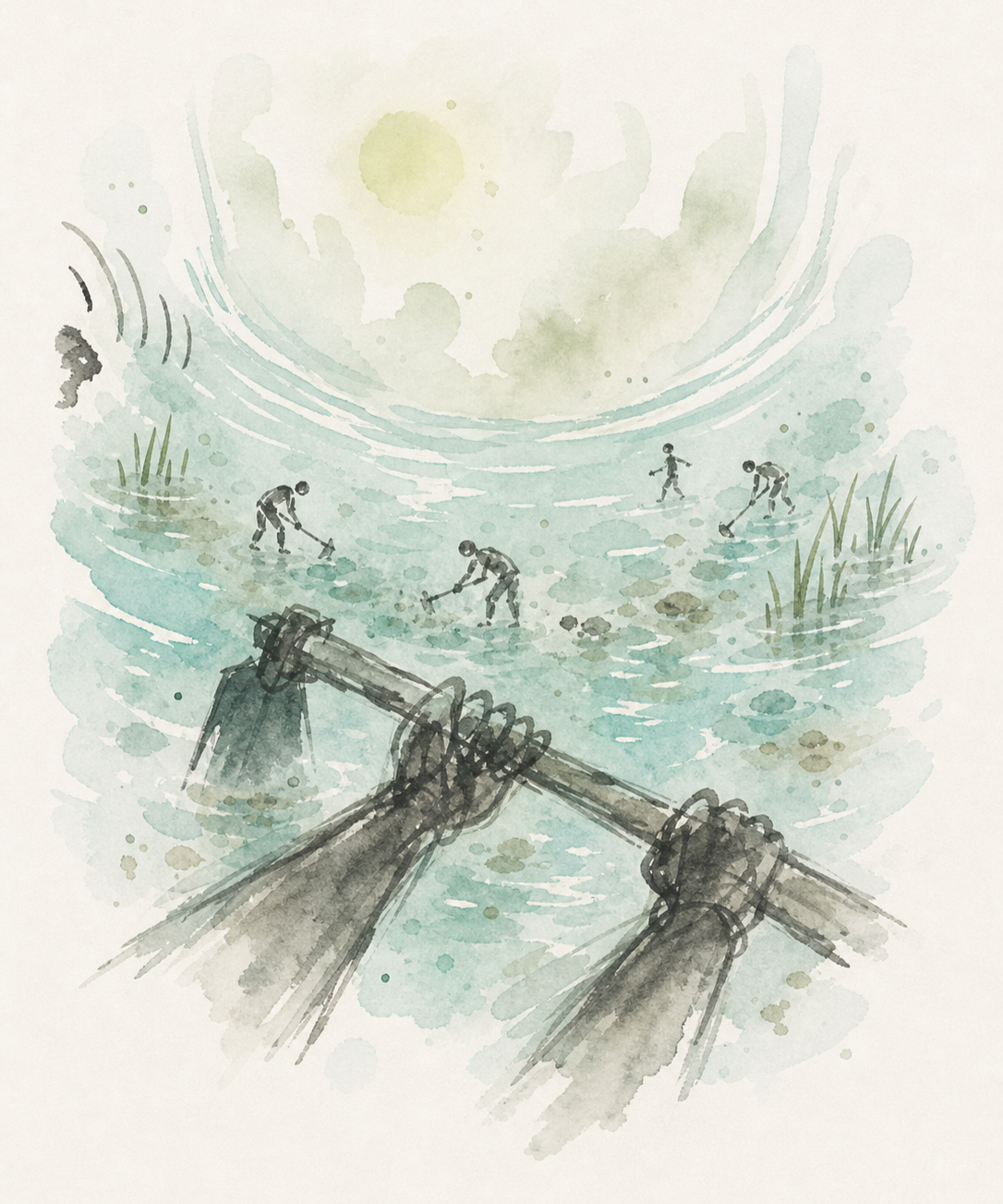
When I returned for the Youth Day activity to clear an irrigation channel, my project intention was simple: meet some teenagers. But the encounter did not simply execute that intention.
The smooth hoe handle, the weight of the mud, the local contractor’s joking instructions, a student’s burst blister, and the village secretary’s remark about “this kind of labour” changed what, and who, became perceptible. The teenagers were no longer elusive project participants, nor was the contractor merely responsible for renovation. The channel was no longer just a background setting for engagement, and I was no longer only a designer seeking access. The situation cooked me, too.
An autoethnographic drawing should therefore not claim, “Here is the village and all its relations.” It can only say, “Here is how this relational world became perceptible and actionable from where I was situated within it.”
This is close to Lucy Suchman’s insistence on located accountability. A partial perspective is not simply an unfortunate limitation that better data (or evidence) will eventually overcome. It is the position from which I encounter others, make judgments, and become answerable for what I do.
[Visual experiment 4: The irrigation-channel episode from bodily eye level. Show only what was available from my position: the hoe handle, water, mud, teenagers’ bodies at work, the local contractor’s voice from one side, and the village secretary moving between groups. Around the edges, leave the rest of the “network” deliberately incomplete or out of view. (Developed with ChatGPT based on iPad sketches.)]
More than one cook
Positioning the design practitioner inside the stew means that she is an intentional ingredient.
I notice, introduce, propose, translate, follow concerns, and sometimes deliberately alter the conditions of an encounter. Cooking names this reflexive, intentional, and interventional mode of participation.
But I am far from being the only intentional ingredient in the stew
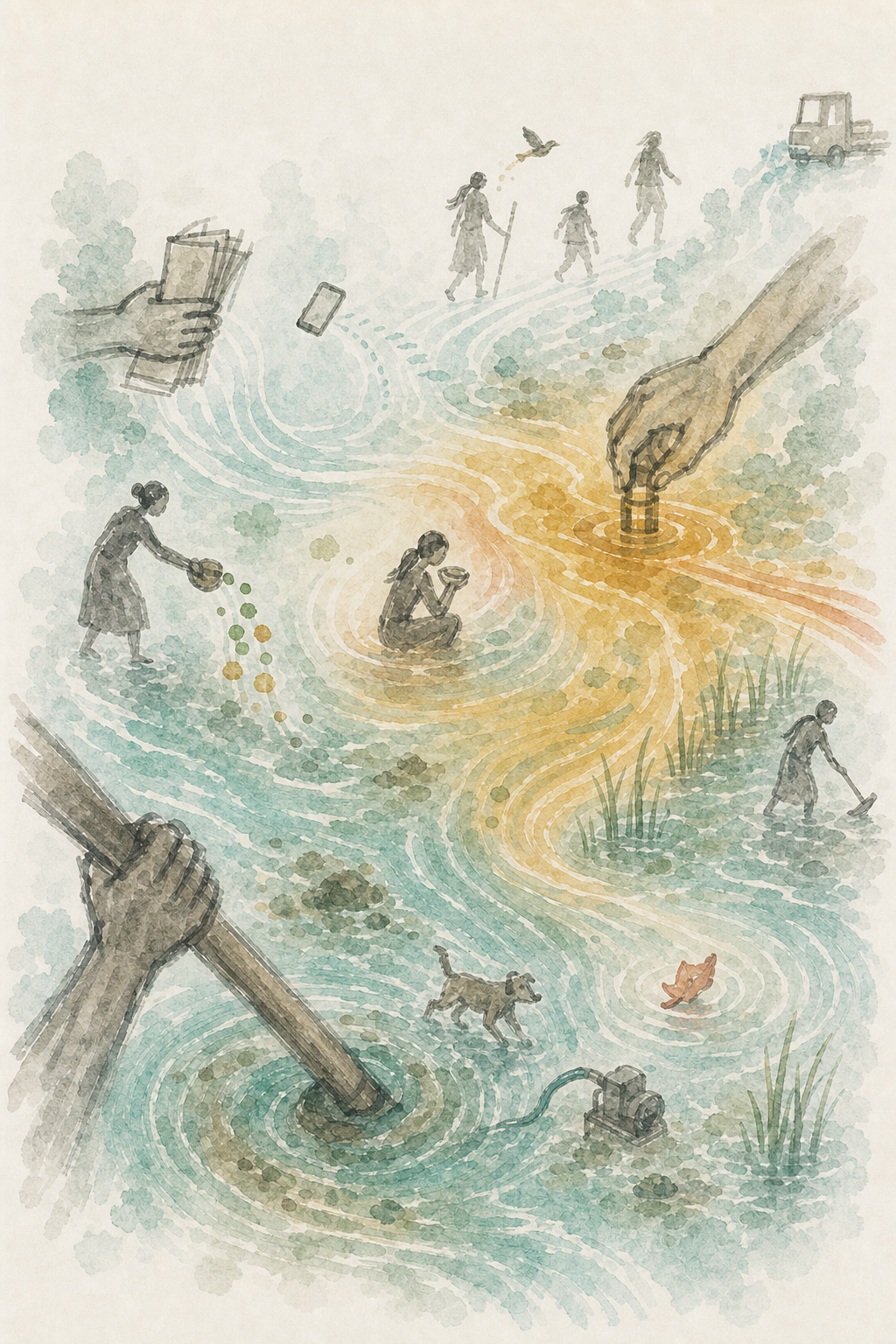
The village secretary may cook through hosting, introducing, remembering families, administrative power, and translating between village life and institutional programmes. Charity representatives may cook through funding arrangements, reporting requirements, project schedules, and the credibility they lend me. Residents cook through hospitality, stories, refusals, invitations, practical knowledge, and decisions about whether I should be trusted with a concern. Children and teenagers cook through appearing, disappearing, participating, resisting, and redirecting adult expectations.
Each person encounters and alters the situation through a position in the stew. We do not merge into a single collective consciousness, just as the ingredients in a stew do not become a homogenized liquid. Our worlds overlap and affect one another without becoming identical.
Nor do we have equal access to the pot. Some actors control funding, project timelines, and the official recipe. Others supply ingredients without being recognized as cooks. Some can leave when the funded project ends. Others remain responsible for whatever expectations and relationships have been created. The stew metaphor should not make the situation appear naturally harmonious. It needs to retain difference, conflict, refusal, and unequal authority.
[Visual experiment 5: Several partial “cooking gestures” occurring within the same stew—stirring, adding, tasting, withholding, adjusting heat. Associate them with different situated actors without placing any single cook outside or above the pot. Show unequal reach: whose hand can change the heat, whose ingredient is ignored, and who must remain after others leave? (Developed with ChatGPT based on previous image)]
Imaged developed with ChatGPT.
Where is the relational labour?
This experiment began while I was thinking about relational labour. I had been trying to understand the often-unrecognized work through which a formally authorized designer becomes relationally implicated in community life.
The stew metaphor helps me distinguish the relational situation from the work that sustains it.
The stew is not the labour. Nor is the cook the labour.
Relational labour could be the practice of cooking: sensing, tending, adjusting, waiting, returning, carrying concerns, negotiating boundaries, and deciding when not to intervene. It is the effort required to maintain a medium through which heterogeneous people, institutions, materials, and concerns can become mutually responsive.
This labour does not simply add links to a network or prepare a stable ground upon which co-design can later occur. It continually alters the substance we are immersed in. Through it, new participants become perceptible, concerns begin to circulate, the object of design changes, and obligations accumulate.
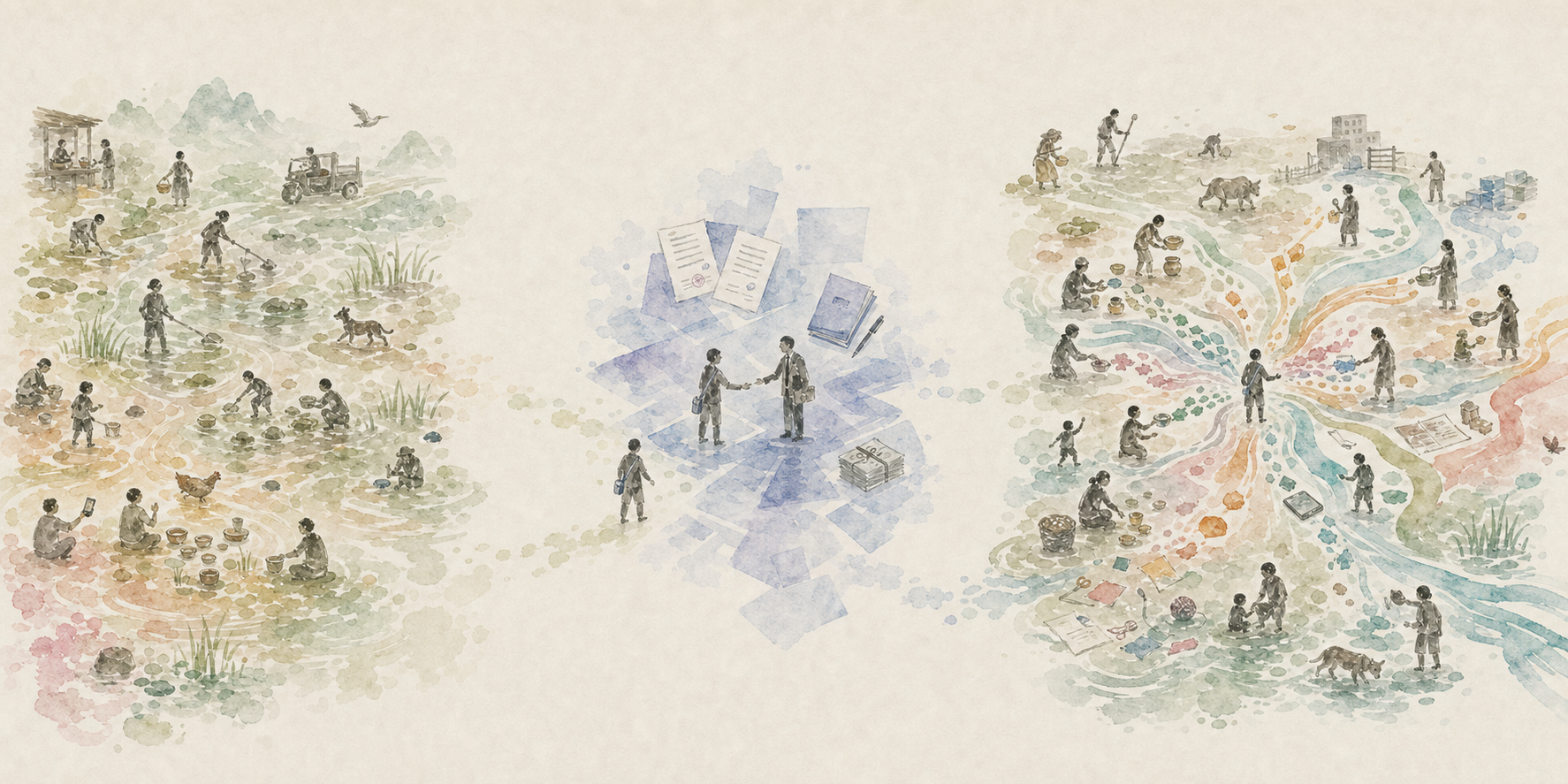
This also complicates the story of “my” entry into the village. I did not produce the relational medium into which I entered. The village secretary, charity workers, residents, families, and many others had already been tending relations long before I arrived. My second (relational) entry depended on accumulated hospitality, credibility, mediation, memory, and care that other people provisionally shared with me.
I entered a stew already simmering.
[Visual experiment 6: A sequential triptych. Panel one: the stew before the designer becomes perceptible—already simmering, but only partially visible from outside the frame. Panel two: my official entry through contracts, credentials, and introduction. Panel three: relational implication, where concerns and obligations now travel through the designer as well. (Developed with ChatGPT based on previous images.]
First from a God's-eye view.
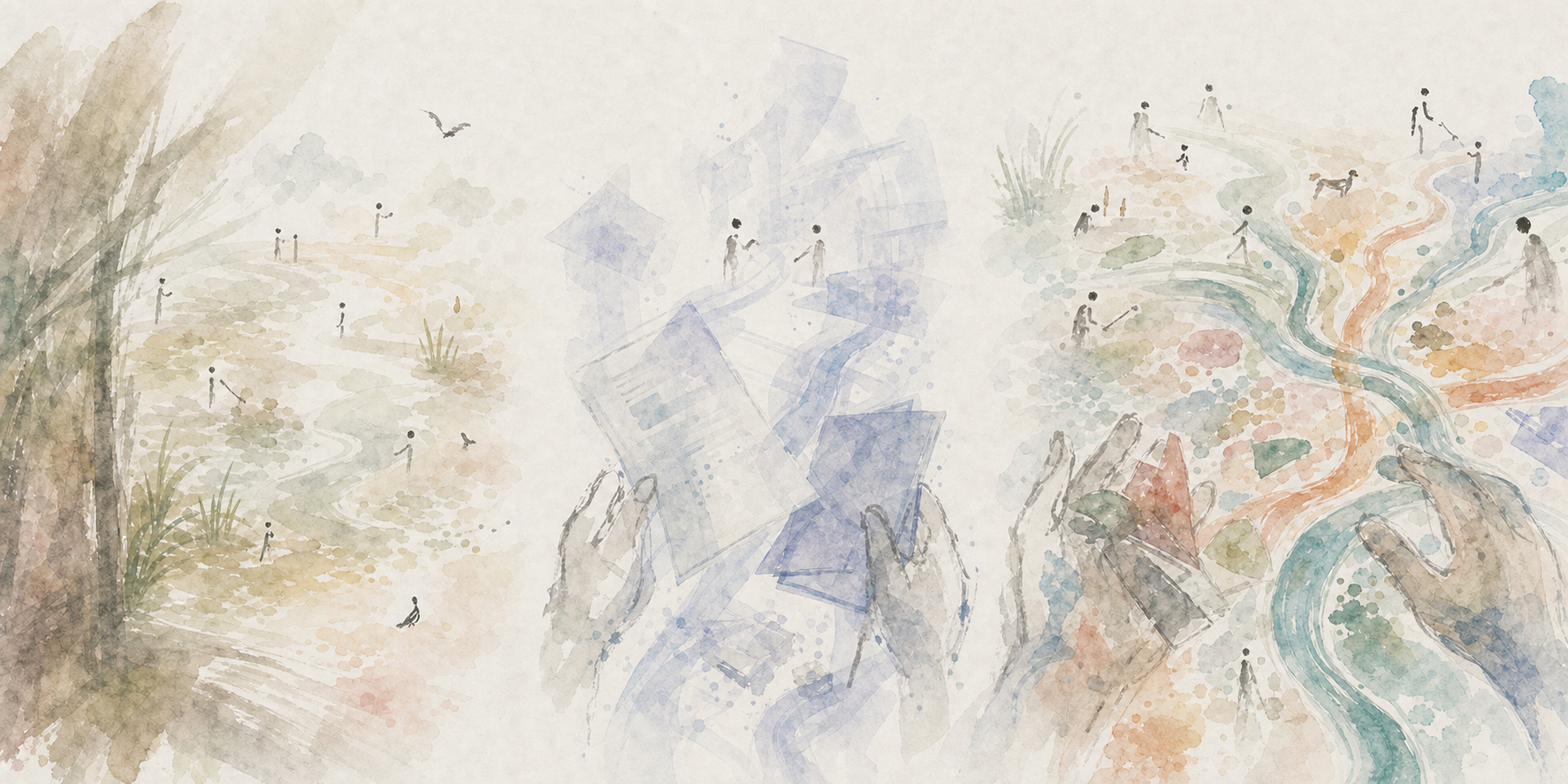
And then from a first-person perspective.
From visual metaphor to a small prototype
As these thoughts accumulated, I began wondering whether stew could become a repeatable visual framework rather than remain an illustrative metaphor. I developed a small browser-based prototype iteratively with ChatGPT, moving between autoethnographic stories, iPad sketches, AI-assisted images, static graphic tests, and successive interactive versions. This was not a linear translation of a finished concept into software. Through 27 iterations, decisions about what could be added, moved, labelled, weighted, or animated repeatedly forced me to clarify what I meant by ingredients, broth, mediation, simmering, cooks, and cooking.
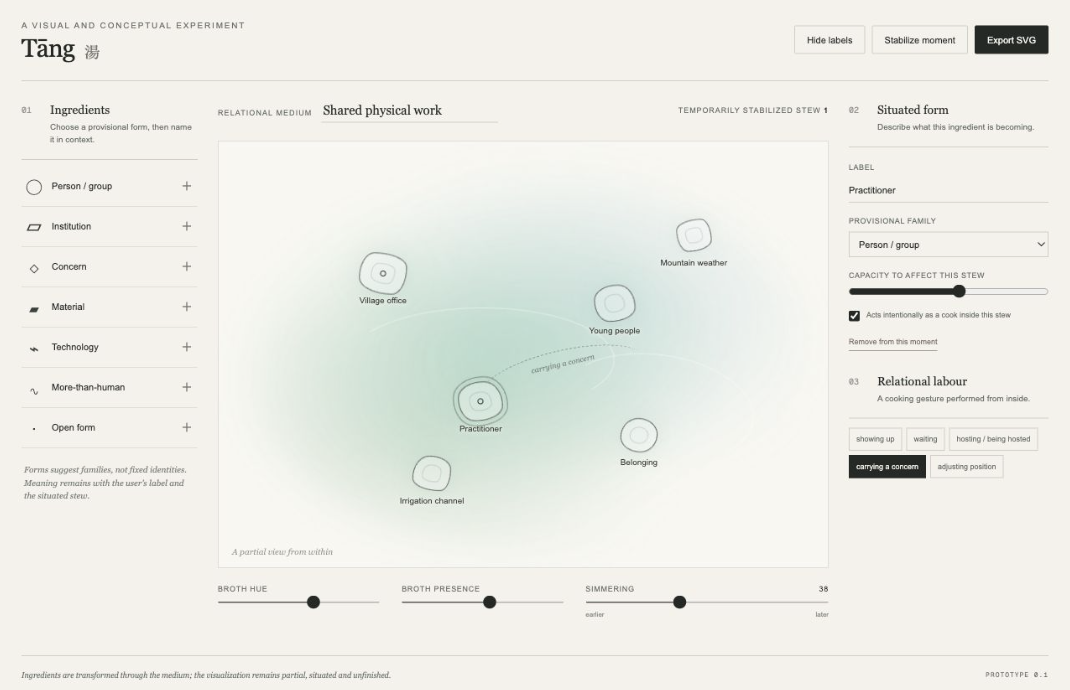
An early prototype established ingredients, cooks, relational labour, and simmering, while still representing mediation through relatively discrete paths and controls
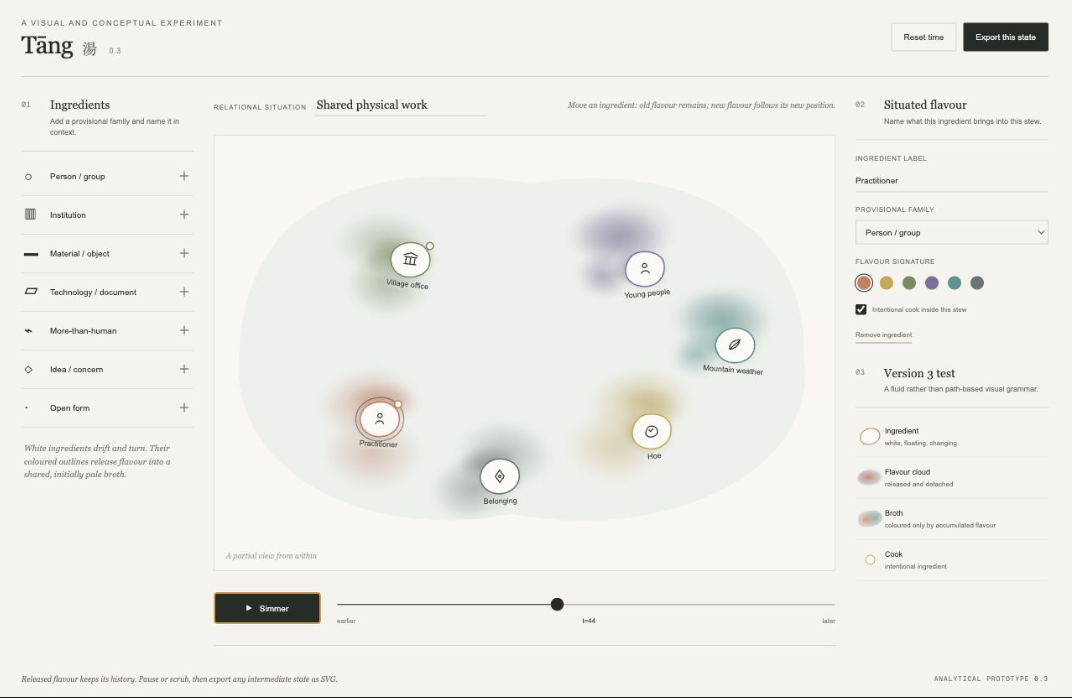
A later experiment replaced connecting paths with drifting colour fields, foregrounding how situated flavours travel, overlap, and begin to compose a broth.
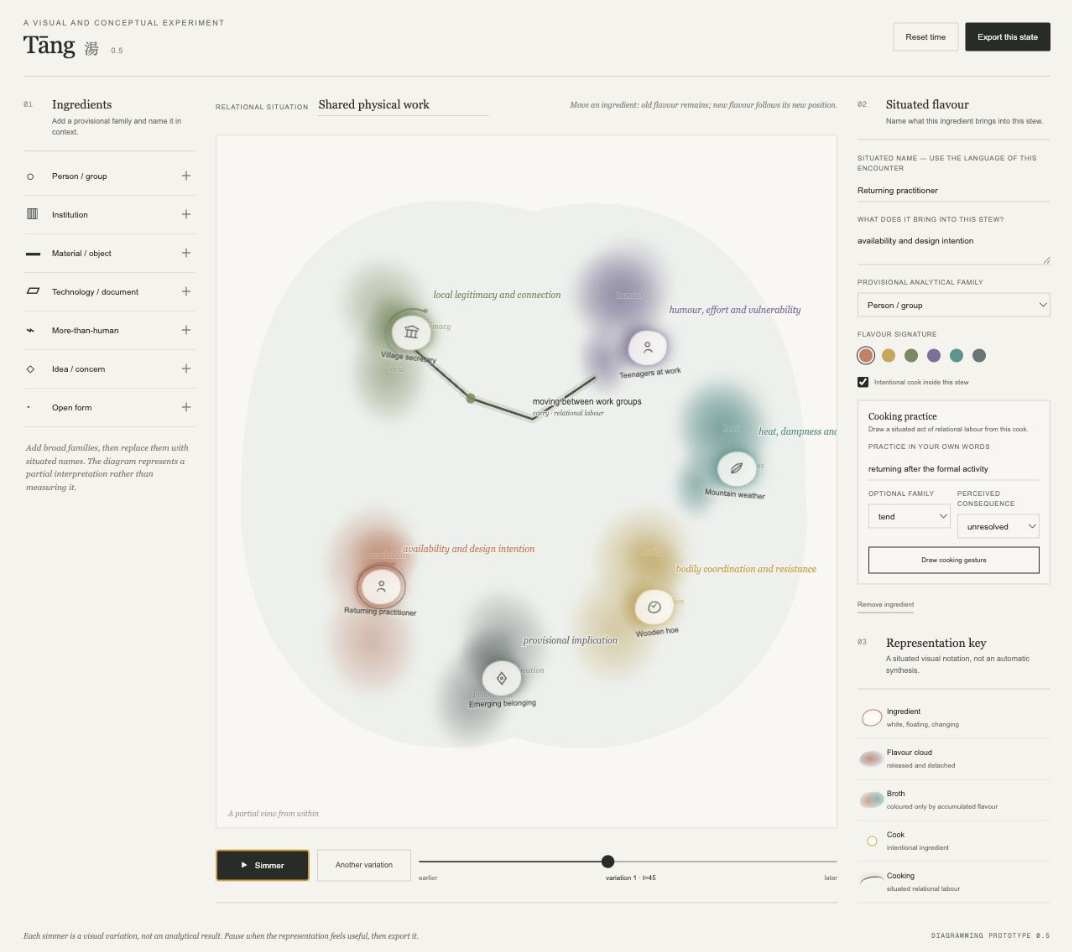
This iteration allowed cooking gestures and their perceived consequences to be explicitly drawn. The feature was later removed because it introduced visual and analytical clutter.
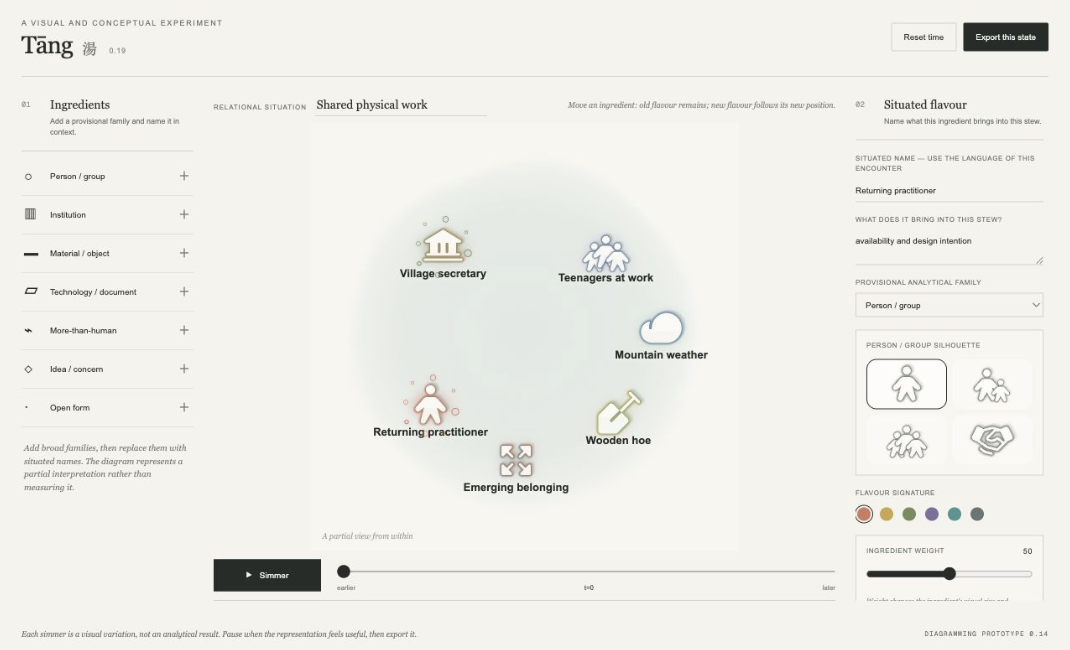
A subsequent iteration gathered ingredients and flavour fields within a soft circular boundary, making separate outputs easier to recognize and compare as distinct stews.
Finally, this is the current version that I have landed on. Here’s how it might simmer.
In the prototype, users identify and situationally name ingredients, describe what each brings into the stew as travelling flavour, mark intentional cooks, and name their cooking practices. During simmering, ingredients move, release and absorb colour, while their accumulated flavours compose the broth. A user can then pause and export a temporarily stabilized state, with a companion legend describing the situation, the qualities composing its broth, and the practices of those cooking from within.
The prototype does not conduct stew analysis automatically. It provides a representational surface and a framework through which a researcher must do analytical work by making situated judgments by interacting with the left and right-hand side panels: what to foreground as an ingredient, how to name it in this encounter, what it brings into circulation, whose practices count as cooking, and what a particular configuration may make perceptible. The resulting diagram is therefore not a neutral map or synthesized answer, but a provisional analytical proposition.
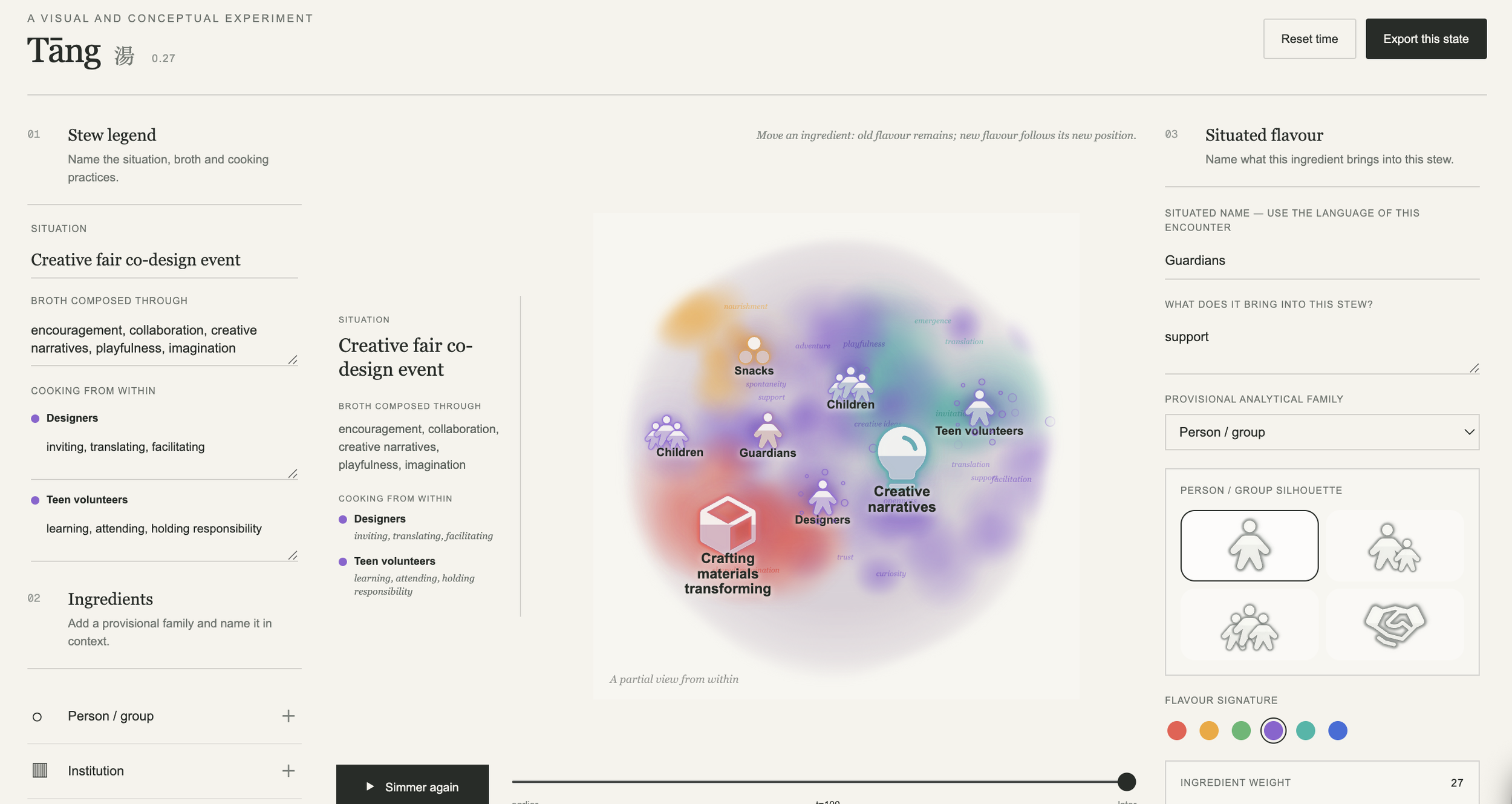
Its present limits are equally important. The prototype still stabilizes the stew from an overhead vantage point; it cannot reproduce the partial, bodily perspective explored in my first-person sketches. Its simmering visualizes duration and transformation but does not reconstruct an empirical chronology. Nor can it determine whether mediation occurred, distinguish intended action from actual effect, or adequately represent refusal, incompatible worlds, unequal access to the heat, and labour that leaves no visible trace. The sketches and prototype therefore remain complementary experiments rather than interchangeable views.
Towards a “stew analysis”?
Although this experiment emerged from community-based co-design, the relational processes it foregrounds are not exclusive to design. Stew might be useful wherever the question is not simply who is connected, but how a mediating situation changes who and what its participants can become. Co-design remains the situated context in which I can presently test the metaphor; whether it can travel further should depend on what it enables others to notice in their own relational worlds.
Summarizing elements of the stew metaphor
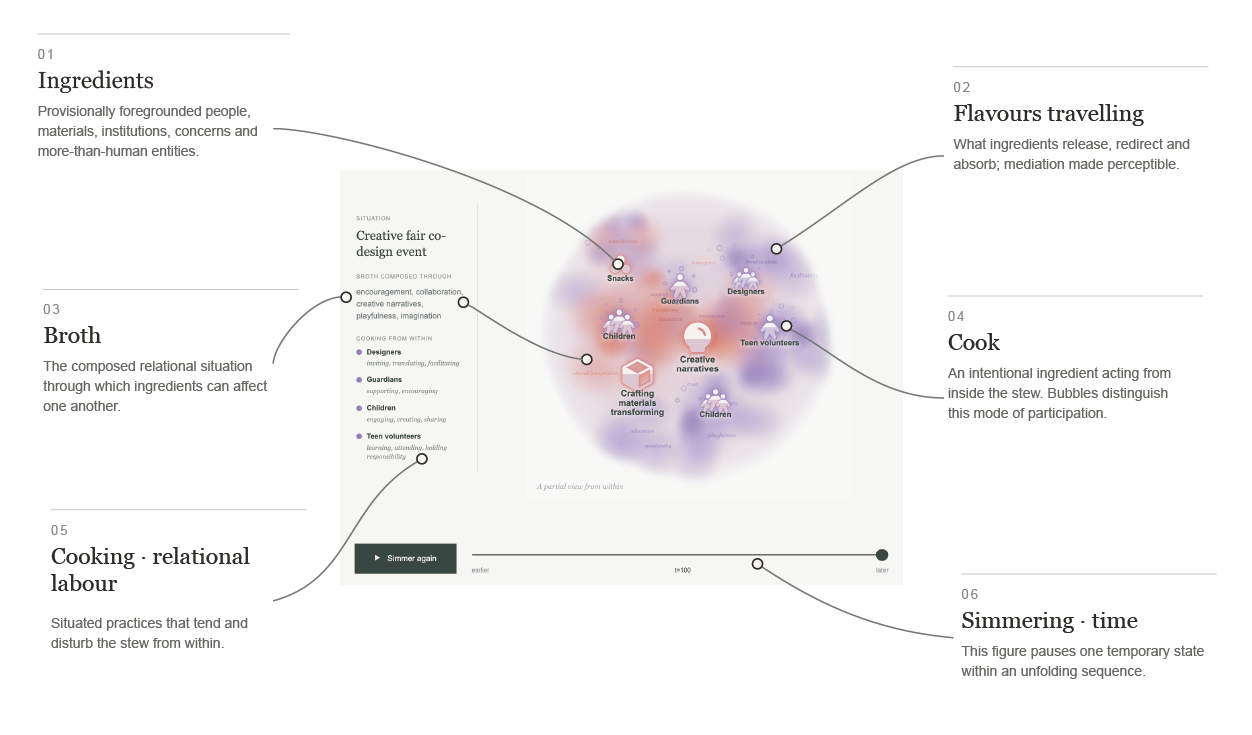
Ingredients: people, institutions, and more-than-human entities such as materials, animals, concerns, and technologies. Ingredients are not fixed actors. Through the process of simmering, they transform the broth and are themselves transformed.
Broth: The relational medium. Not simply a connection between actors, but the environment through which actors become able to affect one another. Examples: a meal; shared physical work; a ritual.
Simmering: Time.
Cook: The practitioner-designer, and other intentional actors. The cooks are fully inside the soup, intentionally acting on the situation and being transformed at the same time.
Relational labour: The practice of cooking from inside the stew. Tending the conditions through which a shared situation can emerge. It includes showing up, waiting, hosting and being hosted, carrying concerns across boundaries, adjusting one's own position etc.
Stew might not become a replacement for stakeholder mapping, but it could become a visual and conceptual experiment that prompts a different act of noticing.
The network asks:
Who are the actors?
Who is connected to whom?
In what ways are they connected?
How has the network expanded?
What does the overall network structure say?
The stew asks:
Through what medium do these beings become capable of affecting one another?
What has each encounter transformed?
What becomes perceptible only through time and immersion?
How do earlier relations flavour later possibilities?
Who tends the medium, and whose labour disappears into it?
From whose position is this stew being sensed?
Who controls the heat, and who remains responsible when others leave?
Every metaphor foregrounds certain things and obscures others. A stew may romanticize togetherness, imply nourishment where there is exploitation, or make slow transformation sound naturally desirable. It may struggle to show conflict, refusal, ingredients that never belong in the same pot, or people who have very unequal access to the heat. Those limits need to remain part of the experiment.
Still, stew helped me understand why my first drawing felt insufficient. The concentric circles showed that my relational world was expanding. They could not show how the medium was changing, how it changed me, or how new responsibilities became difficult to separate from the formal design project.
If this metaphor were developed into a tentative stew analysis, there are many questions I still need to ask:
How could the medium be made more perceptible? How might a map show the places, tools, hospitality, memory, bodily effort, mood, and histories through which people become related?
How would transformation be better traced? What would count as evidence that an encounter changed who or what an actor could be, rather than merely adding another connection?
How would time enter the analysis better? Could sequential stews show how earlier encounters season later ones without implying a smooth or inevitable progression?
From whose position would the stew be sensed? How might several situated accounts coexist without being collapsed into a God’s-eye view?
How would labour and power remain visible? Who tends the broth, supplies the ingredients, controls the heat, decides the recipe, or remains responsible after others leave?
How would the metaphor represent refusal and incompatibility? Can a stew show actors who resist transformation, ingredients that are excluded, or worlds that should not be forced into the same pot?
When would a network remain the better tool? Might network and stew analyses reveal different aspects of the same situation rather than competing for a single correct representation?
More...
I do not yet have answers to these questions. I offer stew analysis not as a finished method, but as an invitation to test what another metaphor might allow us to notice. Perhaps I will take these questions to the field and the workshops where other design researchers are interested in the same ideas.
To be continued...
Footnotes:
[1] This broth-centred culinary logic is not unique to Chinese culture. It has family resemblances across East and Southeast Asia: Japanese cuisine treats dashi as fundamental to the taste of soups; Korean gomtang develops its broth by simmering different cuts of beef for many hours; and Vietnamese canh chua and Indonesian soto similarly bring distinct ingredients together through broths that carry sourness, herbs, aromatics, or spice. These are not culturally interchangeable dishes, and the relative importance of broth and solids varies among them. I mention them only to situate tāng within a wider regional repertoire in which the medium is often an active and valued part of the meal.
[2]Acknowledging earlier soups:
Soup is not a new metaphor in social and intellectual thought. It has appeared in discussions of culture, knowledge production, social immersion, and interconnected worlds—sometimes to emphasize mixture, sometimes compositeness, and sometimes the impossibility of observing social life from outside. I therefore do not claim soup itself as an original metaphor. My more specific experiment is to begin from tāng, foreground the broth as a valued mediator, and ask whether stew can be developed into a sequential visual analysis of how relational situations transform their participants.