
Preparing for the field as a Heideggerian practice
1. What I was taught broke down in the real world
“We are creatures who happen to be here, and as such creatures, we come to love this and devote ourselves to that.” (Chen [陈], 2012, p. 8)
For over ten years, I’ve been invited to design and facilitate training programs for young people interested in social innovation and design for change.
I believe that identifying real-life social needs worth responding to through personal action was one of the most challenging tasks a young person can take on—not only because it often feels like a David-and-Goliath battle, but also because social issues seem so amorphous, while the actions we take are expected to be clearly structured and convincing.
Working with these younger versions of myself, I shared their eagerness to acquire solid frameworks and tools, as if they encode an algorithm, to identify problems, develop plans, execute actions, and evaluate outcomes. It seemed we could always strive to be more scientific, more rational, more in control.
Yet, as someone who is ultimately more a practitioner than a trainer, and through years of participating in social innovation projects both large and small, my trusting relationship with these predefined steps has long been falling apart. In the real world, predetermined goals often become the most unfortunate constraints, while uncertainty gives rise to unexpected openings. Personal conviction sustains action when rational reasoning is no longer sufficient. Ironically, in a field that champions replication of "successful pilots" to contexts as wide as possible, the most viable actions on the ground often emerge for deeply situated and particular reasons.
A few years ago, I began to inhabit a different position—that of a practitioner-researcher. Through a more reflexive lens, I started to dwell on this persistent disconnect. As my reading led me to contemporary Chinese philosopher Chen Jiaying [陈嘉映] and Martin Heidegger, I found myself taking a philosophical turn: away from the dominant model of actors “solving problems” from a position external to them, and toward a view in which change is enacted from within our ongoing entanglement and concern with the world.
For the past year and a half, I have been rethinking and experimenting with what it might mean to prepare young practitioners for the field through a more Heideggerian orientation. This article traces the ongoing process of my reflection and experimentation. My intention is not to present a successful case study, but to spark broader conversation about how we approach action, learning, and engagement in social innovation and charitable work.
2. The way we are taught
“Should everyone begin with saving AIDS patients, and only then consider the black bears? Should we all work to solve homelessness, and only when everyone has a place to live, begin to build opera houses? Who would actually live according to such a shadowy order?” (Chen [陈], 2012, p9)
Finding something important enough to respond to is often where we think action must begin.
While a myriad of methodologies, frameworks, and tools exist to guide social innovation—helping us identify important problems, plan strategically, execute, and evaluate—we are ultimately confronted with two fundamental questions:
Out of all the issues in the world, why do I invest in this particular one?
Out of all the possible ways to respond, why do I choose this particular course of action?
These are not technical questions. They are questions of commitment and judgment.
And yet, most popular frameworks—such as IDEO’s Human-Centered Design (HCD) process, the Business Model Canvas for Nonprofits, the Double Diamond, the Logic Model, or the Theory of Change (all of which, I admit, I have taught)—are designed to guide us through an analytical and strategic process that promises clarity. They provide scaffolds for making the actionable out of the abstract.
In practice, however, I have repeatedly observed a different pattern. Young practitioners spend hours, sometimes weeks, collecting data, clustering insights, prioritizing needs, and filling in structured templates. The outputs are often polished and coherent. Yet when asked the two questions above, many remain just as uncertain as before.
This uncertainty is often attributed to a lack of rigor: perhaps these eager minds did not go deep enough, or did not apply the tools correctly. But I would suggest a different diagnosis. The issue lies not in the depth of analysis, but in how these frameworks assume we enter the work in the first place.
Despite their differences, these models share a common premise: we begin by understanding the world as an object and then determine how to act upon it. In this view, the actor stands outside the situation they seek to change—observing, analyzing, and arranging it into diagrams or sticky notes that can be communicated and justified to others (who also stand outside).
The problem with this orientation is not merely that it distances actors from the lives their decisions may reshape. It also positions them as neutral and external to the world they seek to transform. As a result, questions of what matters and what ought to be done are reframed as pseudo-rational problems—ones that seem solvable through sufficient information, careful comparison, and correct reasoning.
Over time, this way of working produces a particular kind of action: initiatives that are well-justified, but weakly held. They can be explained clearly, but struggle to adapt when reality shifts. And when challenges arise, it becomes difficult to say why this work should continue, beyond an institutional or administrative ethic that demands the project be pushed through simply because it was approved.
3. Heidegger’s shift — being-in-the-world
“Some things can only be answered by resonance, never by reproach” (Chen [陈], 2012, p. 9)
It was through reading Chen Jiaying’s engagement with Martin Heidegger that I began to see a way to mend this detachment. At the core of Heidegger’s philosophy is a simple but radical shift: we are not first subjects standing apart from a world that already exists. Rather, it is through our way of existing—what he calls existentiale—that our experience of the world becomes possible.
If the world is not separate from us, but bound up with how we exist, then reality is not something we passively observe, but something that comes into being through our involvement. What matters to us is not selected from a distance, but disclosed through how we are already oriented in the world. In this sense, what concerns us is both something we find ourselves unable to ignore and something that deepens through sustained engagement.

This forms the core philosophical grounding of what I believe makes good training, illustrated in the diagram above. Here, the “I” and the “world” are not independent entities, but become entangled through repeated action, in a process of mutual transformation.
If this view reshapes how we understand what is real, how we know, and how change takes place, then it inevitably carries implications for social innovation and charitable work. More specifically, it departs from dominant approaches in which action is organized as if one could stay nuetral and rational from the world being engaged.
For me, this shift calls for a rethinking of how we come to recognize issues, how we make plans, what it means to act, how we relate to others, and how we evaluate what has been done. In the following sections, I trace how these aspects begin to change in my training design, gradually shaping action into a Heideggerian practice.
4. The intention to act
When a child is drowning beside you, this is not something that happens outside you. It is something you cannot but feel with your whole being—it is your unavoidable “fate.” We do not first choose when things happen; our more fundamental “choice” is what kind of person we become.
(Chen [陈], 2012, p.10)
In Heidegger’s terms, what we come to recognize as an “issue” is not the result of objective discovery, but of disclosure. The world does not first present itself as a set of neutral facts awaiting analysis; it shows up through our being-in-the-world, shaped by what concerns us. We are always already attuned to certain aspects of the world, and it is through this attunement that something comes to stand out as meaningful. What moves us to act, then, is not an abstract problem, but something that addresses us—something that calls.
But this is not to say we simply follow whatever moves us in any given moment without critique. What calls us is the entry point, but not the endpoint of rigor.
In conversing with young practitioners, I named a simple progression:
observation → perspective → issue
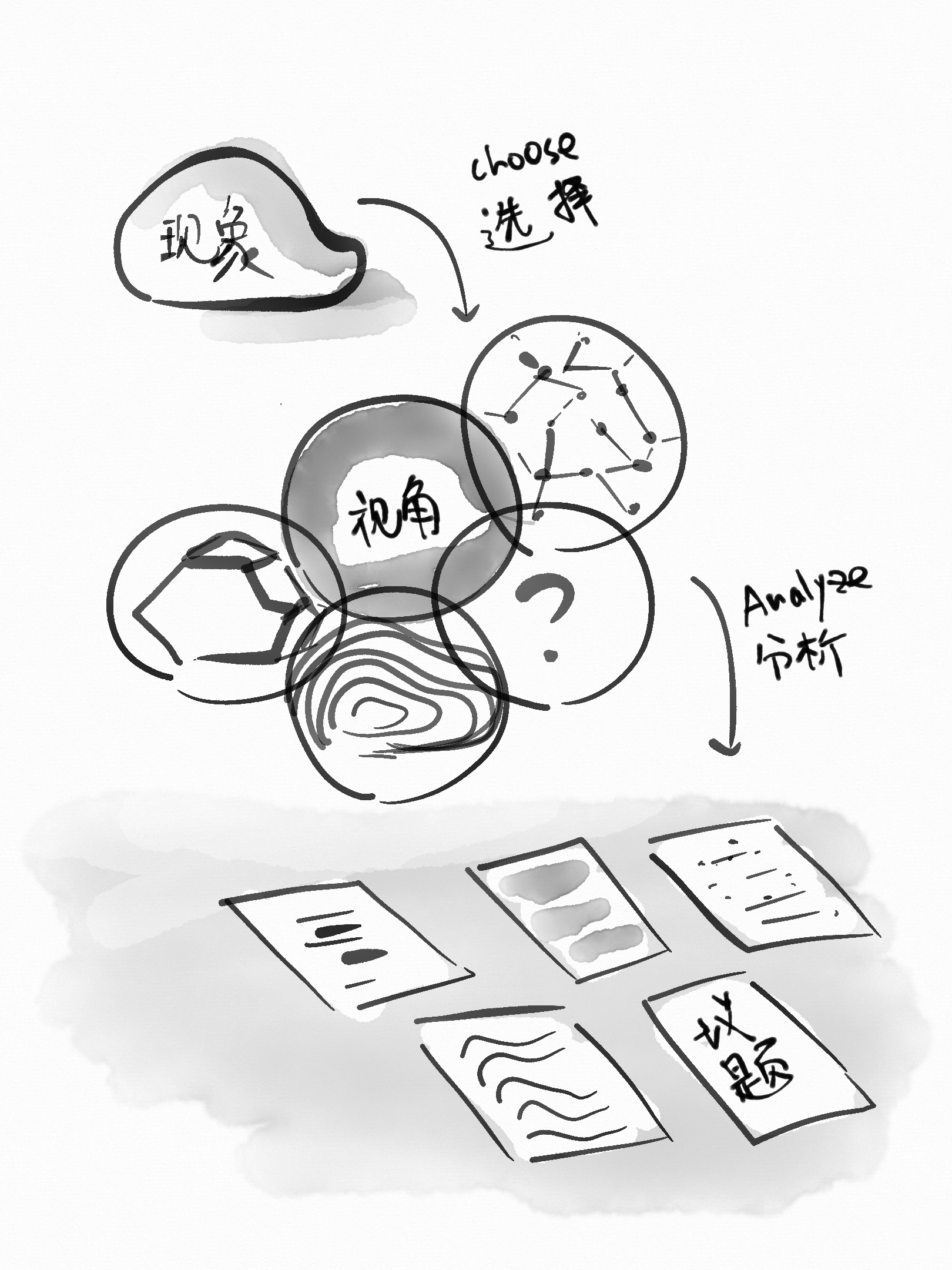
What I call an observation is a fragment of the world that we cannot help but notice in lived reality.
What I call a perspective is an analytical lens that brings certain aspects of an observation into focus. Different lenses not only shape how the observation is understood, but also suggest the direction of action.
What I call an issue emerges when an observation, seen through one or more perspectives, comes to be understood as something worth responding to collectively.
In a workshop, I would prompt everyone to "feel for an observation that they cannot let go of", and then analyze them through different analytical lenses—such as gap, structural, cultural, or relational perspectives—before gradually arriving at framing an issue that invites collective response.
In one session, the room quickly filled with the small disturbances of everyday rural teaching life: students not brushing their teeth, repeating crude online slang, lingering at unsafe intersections after school, or showing early curiosity about romantic relationships. These were not presented as formal “issues,” but as things practitioners found themselves unable to stop thinking about.
Rather than immediately categorizing them through predefined frameworks or external priorities, we stayed with these moments and worked through them using different analytical lenses. As the conversation unfolded, what first appeared merely “annoying” or incidental began to shift in meaning. Students gathering at dangerous intersections after school, for instance, came to be seen through a structural lens as a gap in responsibility between schools and families. Meanwhile, crude online slang, viewed through a cultural lens, revealed a curiosity about language, expression, and social belonging.
What is at stake here is not a rejection of analysis, but a reordering of where it begins. In more dominant approaches, issues are often identified through aggregated data, comparative metrics, or expert judgment—approaches that tend to position the problem as something to be defined from a distance, and to encourage practitioners to set aside their personal concerns in order to maintain neutrality. Here, the starting point is different: it begins from what captures the attention and concern of those already engaged in the situation. Analytical lenses are not used to determine what should matter, but to deepen and articulate what already does.
It is through this attunement that practitioners begin to locate issues they are willing to stay with—issues that can sustain attention and effort over time. In Heidegger’s terms, this is not simply a matter of choosing what to act on, but of responding from within our being-in-the-world, where what matters is already disclosed through care. From this ground, analytical clarity and professional practice begin to take shape.
5. Planning for depth
“What distinguishes knowing something in depth from knowing it superficially is whether knowledge has become embodied by a person. I may know a principle, yet it may remain only part of a public system of knowledge. Though I know about it, I may not yet know it viscerally.” (Chen [chen], 2015, p. 141)
In a Heideggerian sense, planning cannot be understood as the application of prior knowledge to future action. We do not first achieve clarity and then act; rather, understanding unfolds within action itself. The world does not wait to be fully known before we intervene in it. Instead, it becomes intelligible through our engagement—through what we try, what resists, and what begins to take shape in the process.
This has direct implications for how planning is approached in practice. In more dominant models, planning is oriented toward clarity in advance: defining goals, mapping steps, and minimizing uncertainty before action begins. Here, planning begins from a different premise—that we are always acting in partial clarity, and that understanding can only deepen through doing.
For example, in a training and support program, practitioners were invited to think in a rhythm of small, intentional moves and design low-stakes actions that can be prepared within one to two weeks. These actions are not treated as pilot solutions, but as ways of entering more fully into the situation—testing assumptions, encountering constraints, and generating new questions. Each action is followed by reflection, which informs the next iteration: deepening, adjusting, or redirecting the work.
To support this process, I provide several possible pathways for sustained engagement over a three-month period. These include organizing a community event within limited resources, building a local network of collaborators, developing a grant application, or conducting an initial impact evaluation. Rather than fixed plans to be executed, these pathways serve as scaffolds—orientations that practitioners can adapt according to their context, interests, and evolving understanding.
Importantly, support does not end with a one-off training camp. Because situations inevitably unfold in unexpected—and sometimes risky—ways once action begins, additional resources and guidance are made available over the following three months. This extended support is designed not to ensure compliance with a plan, but to accompany practitioners as their understanding develops through action. What matters is that they learn to trust their situated experiences within each endeavour, allowing these experiences to illuminate the path forward.
What is at stake here is not simply a different tempo of planning, but a different understanding of what it means to understand. In Heidegger’s terms, understanding is not a detached grasp of the world, but a form of competence—a way of being able to go on within it. We come to understand a situation not by fully representing it in advance, but by engaging with it through what he calls circumspection: trying things out, adjusting, and gradually finding our way.
In this sense, planning is not about determining what will happen, but creating the conditions that allow understanding to continue.
6. Execution to transform and be transformed
“Knowing is the beginning of action, and action is the fulfillment of knowing.”(Wang Yangming [王阳明], Ming dynasty)*
“We design our world, while our world acts back on us and designs us.” (Willis, 2006, p. 80)
“Design designs.” (Escobar, 2018, p. 110)
Both Heidegger and Wang Yangming collapse knowing and acting into a single process. Building on this, design philosophers further suggest that as we shape the world, the world simultaneously shapes us. Action, in this sense, is not a one-directional intervention, but a recursive process of mutual transformation.
If this is the case, execution is not the implementation of a plan, but a process through which the actor is transformed alongside the situation. Rather than being evaluated by alignment with intended outcomes, it calls for continuous attention to what changes in us—our assumptions, sensitivities, and capacities.
In a training and support program, this is reflected in how capacity building is embedded within action itself. A structured tree-map of capacities is introduced—not as a checklist to be completed, but as a way of noticing how different forms of engagement call for different skills.

With each action, practitioners are encouraged not only to reflect on how it impacts the world, but also on how it reshapes their own ways of seeing and acting. This is also more practical because, for young practitioners, tracking skill development is often more tangible than tracking changes at the community level.
For instance, one capacity on the map is the ability to mobilize local human and material resources for collective action. A first step might be to design and publish a recruitment poster or message for the community, documenting both the process and the response. When done well, this already constitutes a small but real intervention—while simultaneously building the participant’s ability to communicate, reach out, and engage others. From here, the next step might be to plan and facilitate a small community mobilization meeting, developing tools to guide the process and record interactions. In this way, each action does not merely apply a skill, but extends it, as the participant learns to navigate increasingly complex situations.
In this sense, execution becomes the ongoing formation of understanding and capacity through engagement with the real. As practitioners act, small but tangible impacts emerge alongside shifts in their own abilities. Skills that begin as vague are gradually sharpened through this process, as understanding and capability take shape together. For many young practitioners, focusing on this development of capacity offers a more immediate and practical way to orient their work.
7. Being-with-others
“You may have your own orientations in life, but you do not arrive at them as an atomized individual. All of one’s orientations emerge within a community; indeed, apart from society, one could not even come to know who one is.” (Chen [陈], 2015, p. 192)
"The story of my life is always embedded in the story of those communities from which I derive my identity.”
(Alasdair MacIntyre After Virtue, Chapter 15)
So far, I may have described practitioners as if they were acting as individual agents. However, in a Heideggerian sense—especially when applied to community-based and charitable practice—action is always already collective.
In Heidegger’s terms, to be is always to be-with (Mitsein). Others are not external participants we later bring into a process; they are constitutive of how the world shows up to us in the first place. What we notice, how we interpret, and what becomes possible are all shaped through our relations with others.
In this sense, action is never individual. It unfolds within a web of relations that both enables and constrains it—one that becomes increasingly complex and dynamic as practitioners move into more layered social situations.
I suggest that in training and support programs, this is approached not as stakeholder management, but as an ongoing attentiveness to relationships. We can work with real-life stories shared by experienced practitioners and even through games of improvised storytelling to surface how different perspectives are formed, negotiated, and held within a group.
8. Reflective narratives in Evaluation
“Whatever purposes or functions painting may serve, they can never fully contain the activity itself. The practice of painting continuously redefines its own purposes and functions.” (Chen [陈], 2015, p. 104)
To this end, I introduce the practice of reflective narratives—an ongoing process of articulating experience in order to make sense of how meaning is formed through action. As practitioners act, they are encouraged to trace not only what happened, but how it develops into meaning for them.
This is also a practical necessity. The situations we engage with in social innovation are often messy and evolving, while supporting institutions require structured representations—grant proposals, reports, and evaluations. Reflective narratives, developed alongside practice, serve as a bridge between these two conditions, mediating between lived experience and formal articulation.

I would especially encourage practitioners to cultivate reflective practices in less formal ways—sharing stories with peers, posting on social media, or keeping personal journals. These informal contexts create space to engage experience with greater honesty and vulnerability, allowing evaluation to move away from polished success cases and toward more authentic accounts of learning. In this sense, evaluation is not the measurement of outcomes, but the articulation of what has come to be understood.
9. Full circle from within
It has been 21 years since that first summer volunteering experience that led me to a rural school in China. What I thought was a one-month trip lingered as many moments of “what I could not let go of.” To the disbelief of many people around me—myself included—it has now been 15 years since I entered professional work in social innovation. I often think I did not stay because I found success, but because I became increasingly entangled in its difficulties.
For a long while, I imagined that one day I might untangle myself—by "solving a problem" at hand, or by demonstrating that a model could scale into something larger. To this end, I learned and applied many paradigms, methodologies, frameworks, and tools. But over time, I began to notice that I—and many of my colleagues—were less drawn to the promise of resolution than to the persistence of concerns.
The idea that we might be moving from one concern to another, with no clear end, once caused me considerable distress—when would we be done? It was through the writing of Chen Jiayin, and through him the philosophy of Heidegger, that I began to see this differently: perhaps the things that give rise to concern are not simply out there to be removed, but are also bound up with the care and attention that emerge from within us.

In this sense, responding to them is not a demonstration of success to others, but a way of attuning to ourselves. From where I now stand, this has made me less preoccupied with mastering methodologies and tools as mediators between myself and the world, and more attentive to how we might create the conditions that allow us to enter into situations of concern, act within them, and, through that engagement, encounter ourselves.
“When we first ‘choose a path in life,’ no one fully understands their own nature, their surroundings, or how those circumstances may change. Our inability to fully know ourselves at the outset is not due to intellectual immaturity, but to a nature not yet fully formed. It gradually discloses itself to us through the tangled processes of practice.” (Chen [陈], 2015, p. 124)
*Wang Yangming (1472–1529) was a Ming dynasty Confucian philosopher known for developing the concept of the unity of knowing and action (zhixing heyi). Chuanxilu (Instructions for Practical Living) is a collection of his recorded conversations and letters compiled by his students.
_
References
Chen, Jiaying [陈嘉映]. (2012). Reasons for Value [价值的理由]. Beijing: CITIC Publishing Group.
Chen, Jiaying [陈嘉映].. (2015). What Is a Good Life: Walking the Path and Responding to the Heart [何为良好生活:行之于途而应于心] (1st ed.). Shanghai: Shanghai Literature and Art Publishing House.
Escobar, A. (2018). Designs for the Pluriverse: Radical Interdependence, Autonomy, and the Making of Worlds. Duke University Press. https://doi.org/10.1215/9780822371816
Willis, Anne-Marie. 2006. “Ontological Designing—Laying the Ground.” https://www .academia.edu/888457/Ontological_designing.