
02 | Questions, to follow
2026.02
At the end of January, at the invitation of a couple of friends, I took another weekend trip to Yangshuo.
On Sunday afternoon, as the air began to cool, we were wrapping up a day of climbing at the popular Wine Bottle crag, just in time to catch our return high-speed train. Then, suddenly, an unshakable question crept into my mind: Where exactly is Grandma Lu’s vegetable garden in relation to The Egg?
After quickly checking that there was a later train, I hopped into a Didi with my drone. Just 13 minutes later, I was dropped off by the sidewalk on the north side of The Egg. A few steps up through the bushes brought me to my usual climbing spot.
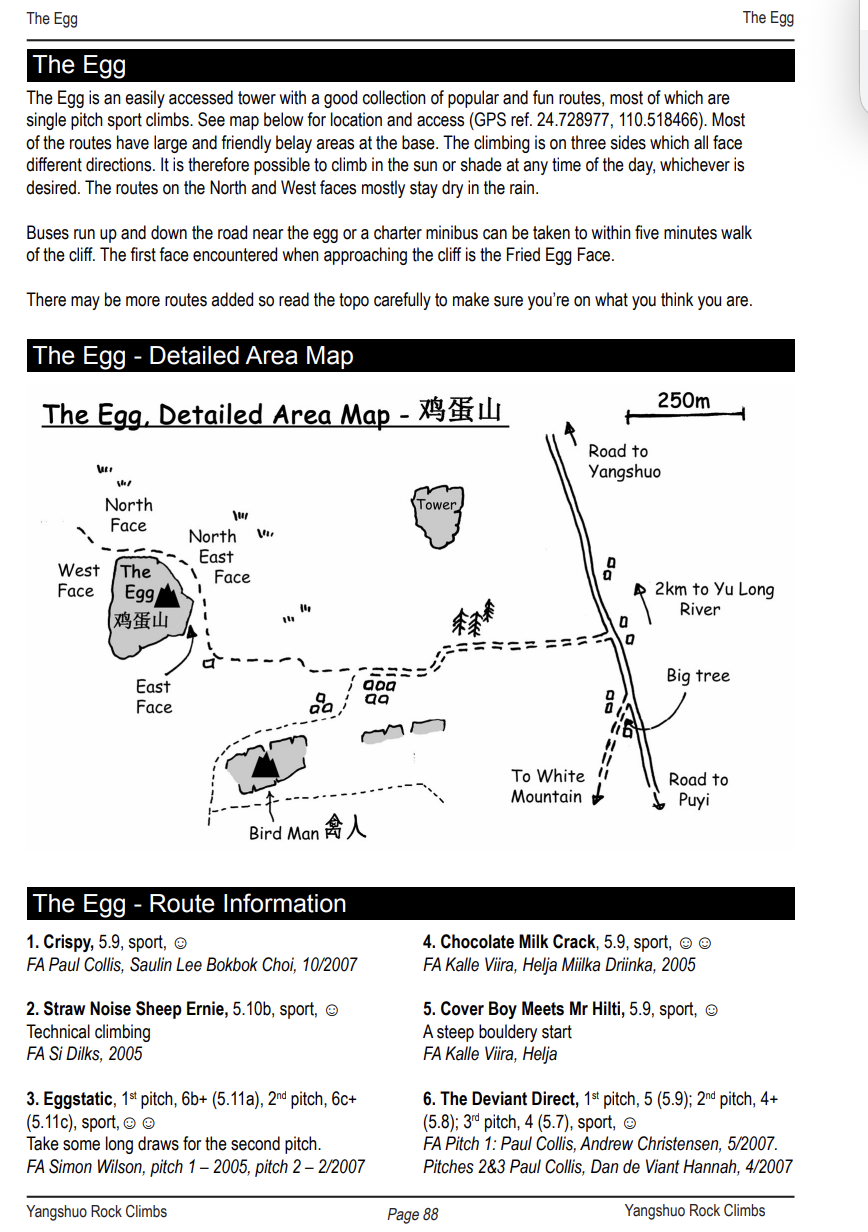
I walked southward along the east side, looking down, but saw no sign of farmland. Then I remembered: the guidebooks, the climbers’ maps of routes and crags, describe The Egg as having four faces. Grandma Lu had said she owned half of it. That could mean two faces.
I walked back down to the sidewalk. A few steps east, I noticed an unpaved path leading south into the greenery.
Within a minute, breathing in the cool forest air, the path opened into a fork. On the left were two large vegetable patches; on the right, a set of steps leading up to a side of The Egg I had never visited.
The vegetable patches were triangular-ish, planted with choy sum, with lush green leaves holding up small yellow flowers that moved lightly in the air. I followed the path away from the crag to the far end of one patch. It seemed to lead toward a small village, with only a few houses. There were no people in sight, no human sounds, only birds.
From there, I launched my drone and flew it up, then toward The Egg. The screen showed a small group of climbers with their gears spread out. I brought the drone back down, landing it gently among the choy sum.
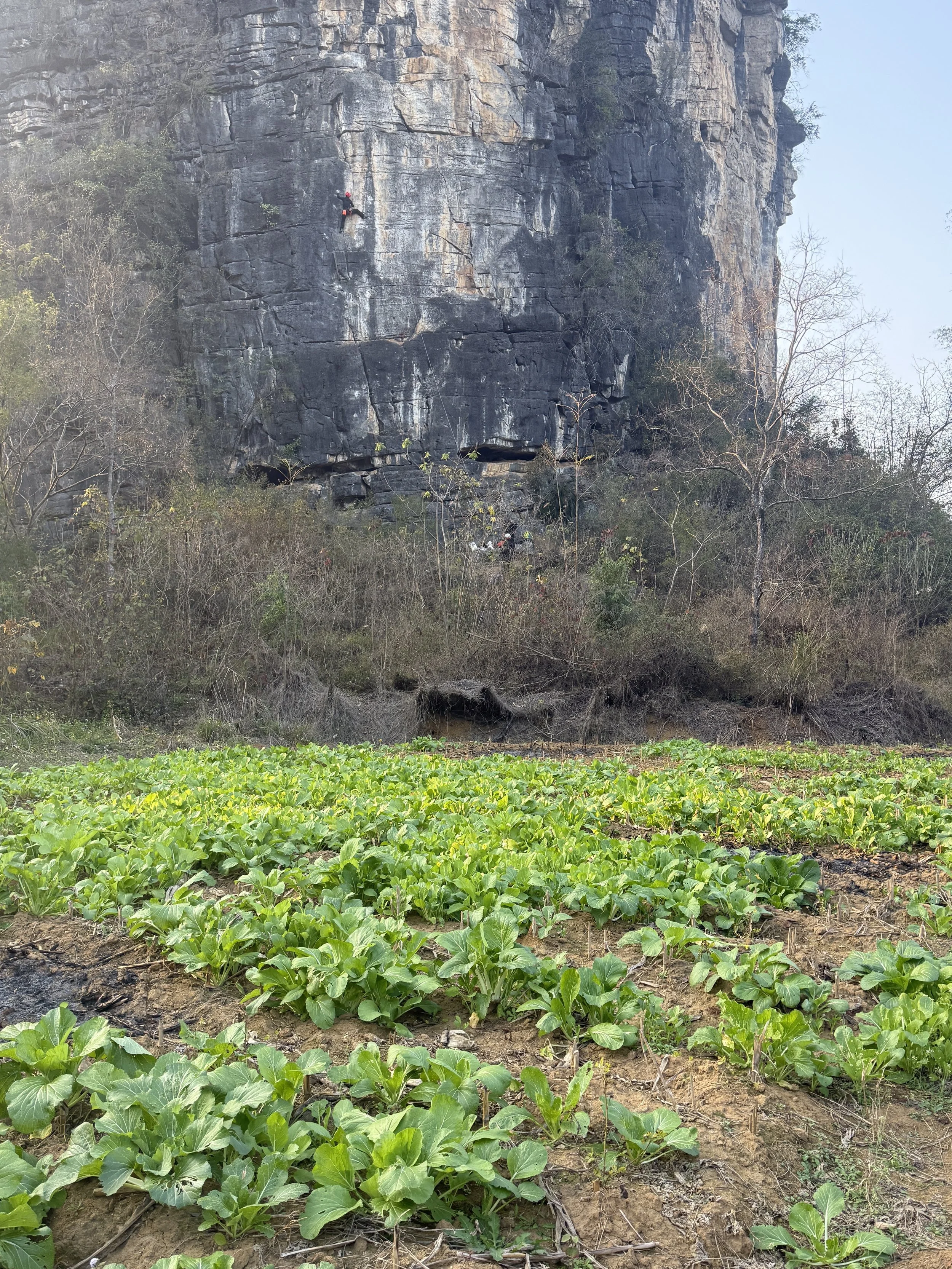
As I stepped into the garden to retrieve it, I looked up.
For the first time, from this distance, the mountain revealed its full shape: unmistakably an egg, its pointed end rising upward. Two climbers clung to the rock face, minuscule like ants. I wondered if this was the view of The Egg that people in Grandma Lu's village were used to.
—
Coming home this time, I asked myself many times why The Egg had captivated my attention. Perhaps I couldn’t shake the discomfort of moving through this place with a name that might not have been its own.
Perhaps I feared that this place, which had always held my escapes, was more fragile than I was willing to see. Perhaps I sensed that the petite, enigmatic figure I had encountered there had stories yet unheard. Or perhaps I was simply looking for a site, free of contracts and KPIs, where I could live out the kind of co-design I believed in.
I began to see The Egg as a journey of inquiry. And a few questions began to take shape:
When a global sport infrastructure and local memory and ritual coalesce in a place, how might one way of knowing come to dominate, while another recedes to the margins?
If multiple ways of knowing a place were recognized, how might relationships between people, practices, and the living and unseen dimensions of this place take shape differently?
How might those connected to this place begin to take part in shaping its future together, in ways that are attentive and grounded in care and responsibility?
—
During and around the Chinese New Year, I found that I didn’t want to sit with these questions and ideas alone. I began sharing them with Jingwen and Kayla.
Jingwen, whom I had first come across online through her graphic work inspired by her bouldering trips in Joshua Tree during her PhD years in the United States, now teaches arts education at a university in Shanghai. Climbing had been both a subject and a companion in her creative work. Kayla, a long-time collaborator in my work in social innovation, had studied Design for Change in Edinburgh, where she began climbing regularly indoors, and had since been moving between rural and urban contexts through her nomadic projects.
What began as a few exchanges of notes and photos quickly turned into a shared curiosity. Somewhere along the way, we half-jokingly began to call ourselves “Grandma Lu’s little fairies.”
Scavenging for time during the New Year holidays, we spent February tracing fragments of how The Egg had first come to be known as a climbing place. We were not just looking for facts. We were trying to understand how the mountain had first been seen, named, and what the first interactions between the early climbers and the locals were like.
From guidebooks, we could see that the earliest climbing routes at The Egg were set between 2005 and 2008. We jotted down the names and scraps of information of route setters and first ascents:
2005
Si Diiks
Kalle Viira
Helja Miilka Driinka (no spelling mistake here!)
2007-2008
Paul Collis (British engineer who lived in Hong Kong)
Andrew Christensen
Dan de Viant Hannah
Dave Gliddon (major route developer in Yangshuo, died in 2017)
Colton Lindeman
Bob Keaty
These fragments began to sketch a different layer of the mountain’s history—one in which The Egg emerged through exploration, naming, and route-making, long before we arrived with our own questions.
At the same time, we tried to locate Denglongshan Village within administrative records. What we were looking for was what is known as a “natural village” (自然村)—an organically formed cluster of households with nearby farmland. Over time, such villages were reorganized into larger administrative units (行政村, administrative villages) for governance and resource distribution. According to local records, Denglongshan had been reassigned several times since the 1950s, and now fell under the Xincheng (New Town) District of Yangshuo—suggesting its gradual absorption into an expanding urban center.
And yet, like many older villagers across China who continue to identify with their original natural villages, Grandma Lu only returned to Denglongshan when speaking of where she was from, the village as it had been lived, rather than as it was administratively defined.
—
Right after the Chinese New Year, Jingwen sent an excited message, she had successfully connected with Kalle Viira, one of the earliest route developers at The Egg, on Instagram. The experienced Finnish climber, who is long back in Finland and still climbing, replied generously, recalling how the crag first came into being 20 years ago.
He described how he and the other two route setters had come across the mountain while scouting on mountain bikes, eventually realizing that its different faces allowed climbing in the shade throughout the day. Early routes were established through a mix of improvisation and endurance—leading on trad gear, placing anchors, and cutting paths through dense vegetation.
“Trust Issues and Scar Tissues,” one of the first routes, carried traces of that process—loose rock, uncertain protection, and scratched skin.
Equipment was limited. “The drill was a Bosch with a bad battery… we could only put in a few bolts each visit.” Development unfolded slowly, route by route.
At one point, they approached a local family living near the crag. Communication was partial, mediated through fragments of Mandarin and local dialect. “I think they said it was called ‘egg mountain,’ because of the shape,” he recalled.
Over time, more climbers joined, more routes appeared, and The Egg began to take shape as a recognizable climbing area.
I couldn’t help but think about the twenty years that had passed since that first bike ride, since a chance glance at one mountain among thousands in Yangshuo, and how it had become a destination for climbers from all over the world. So much had shifted: the people, the technologies, the ways of arriving, and the surrounding landscape, now transformed to the point that it might be unrecognizable to Kalle.
And yet, one petite figure seemed to have remained.
I wondered whether she would be open to the questions we were beginning to carry, whether she would welcome us into the unfolding future of her relationship with this place.
Jingwen, Kayla, and I set a date for Yangshuo.
__
Footnote: Kalle's original messages to Jingwen via Instagram:
> Hello, I am excited that you are reaching out on this matter. I did found the crag and started developing it propably at 2005. There were some rumours about someona having looked at it before but at that time it was still early days of climbing and we were active on finding new walls. We ride mountain bikes and scouted places, eventually propably spotted thenorth-west face first and after going around the mountain realized that it offers good sectors around it, making it possible to climb all day round in the shade, and offering plenty of potential.
>I then recruited Simon Dilks to belay me so I could lead my way up on trad gear to the top to place first anchors. This pioneering line led to a painfull bushwacking with a machete to reach the top of s route called ”From Finland with love” indicating the opening of a new crag. The line up was marked on the guide book with the name ”Trust issues and scar tissues” telling the story of the scary first ascent on loose rock, bad gear and getting bloody scratches fighting through the summit to the top of the wall. As there was lots of lines, nothing was too sensitive, many people joined the routing climbing up first line and traversing to put in new anchors.
> One some esrly days before active bolting we contacted the local family living close to the crag. My friend spoke fluend mandarin but the locals almost only communicated in local dialect, so we managed to get little info at the time. I think they said it was named ”chidan shan”, egg mountain, because of the shape. They were really friedly and invited us to thrir home etc.
>I continud to develop the other sectors by climbing up on trad gear and bolting anchors, then traversing to new lines. Chocolate Milk Crag was climed first on that sector leading to other routes. We always had that to drink. The drill was a Bosch that had bad battery, so we managed to just put some bolts in every visit. When Paul Collis arrived on the spot with his well working Hilti drill by surprise, I was cursing the Bosch. Paul let me drag up his tool and we put up seversl routes in good pace. Route ”Cover boy meets mr. Hilti” tells this story as I used to be on the guidebook cover written by Paul. With Paul we the continued to north-east face with some stories as well.
> The development was exciting, involving traversing and hanging on skyhooks. I am really happy thst The Egg became such a popular area. It has great routes. It has been a while and I have seen some pictures about the area now, with paved roads and so much development. Two decades ago it was peaceful and very rural. The names of the routes tell many stories. I thin in ”Posers lonely reunion” I was hanging on the wall alone when Paul again came to the spot. Hustlers Roof was Pauls project he thought was harder and let me try it and I ”accidentaly” send it first go. So I bolted the Consolation Price for him. I also thought The New Decade was harder, name means it way above 5.10 like the Final Decade that indicates me being boref to find out all routes came to be so easy. I let Yann try the hard one as he wanted to leave a name in the area and I wass working on The Wiggle (you need to throw a dynamic move and ”wiggle” you fingers in to a slot on the crux.
>Handsaw returns indicates s cleanup of bushed like on Wine Bottle crags Helsinki Handsaw Massacre. It was an adventurous and exciting time in Yangshuo. I could tell much more besides the Egg. I remember Paul writing the first guidebook in our balcony in 2003, I kept coming back spring and fall, the guiding work grew, new routes and cliffs came up, international visitors started to show up. Some famous climbers as well. Been planning to come back someday as I am still climbing as good as ever. 🙂 Hope this answers your question, let me know it there is anything else.